
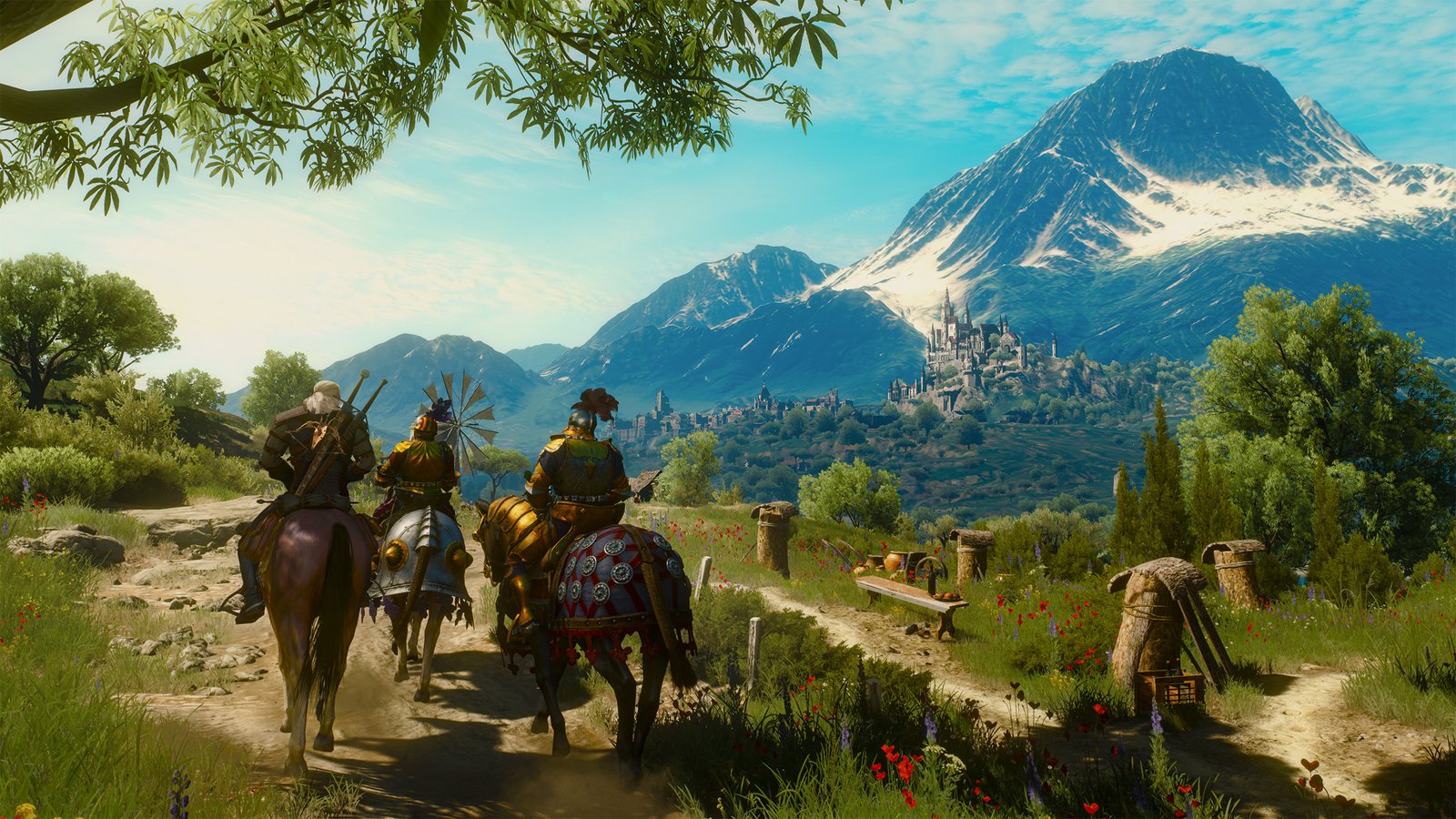
The DLSS 5 Multipass showed a much higher cost when Neural Rendering was executed in two consecutive passes in The Witcher 3: Wild Hunt — Remastered. In a new test published on October 1, 2026, a GeForce RTX 5090 dropped from 80 to just 36 FPS in one of the evaluated scenes.
GameGPU conducted the experiment at 4K, with maximum graphics settings, Path Tracing, and DLSS in Ultra Performance mode. The chain used a RenoDX modification together with DLSSNP libraries to apply neural processing. Therefore, this is a community and experimental implementation, not official DLSS 5 support developed by CD Projekt RED.
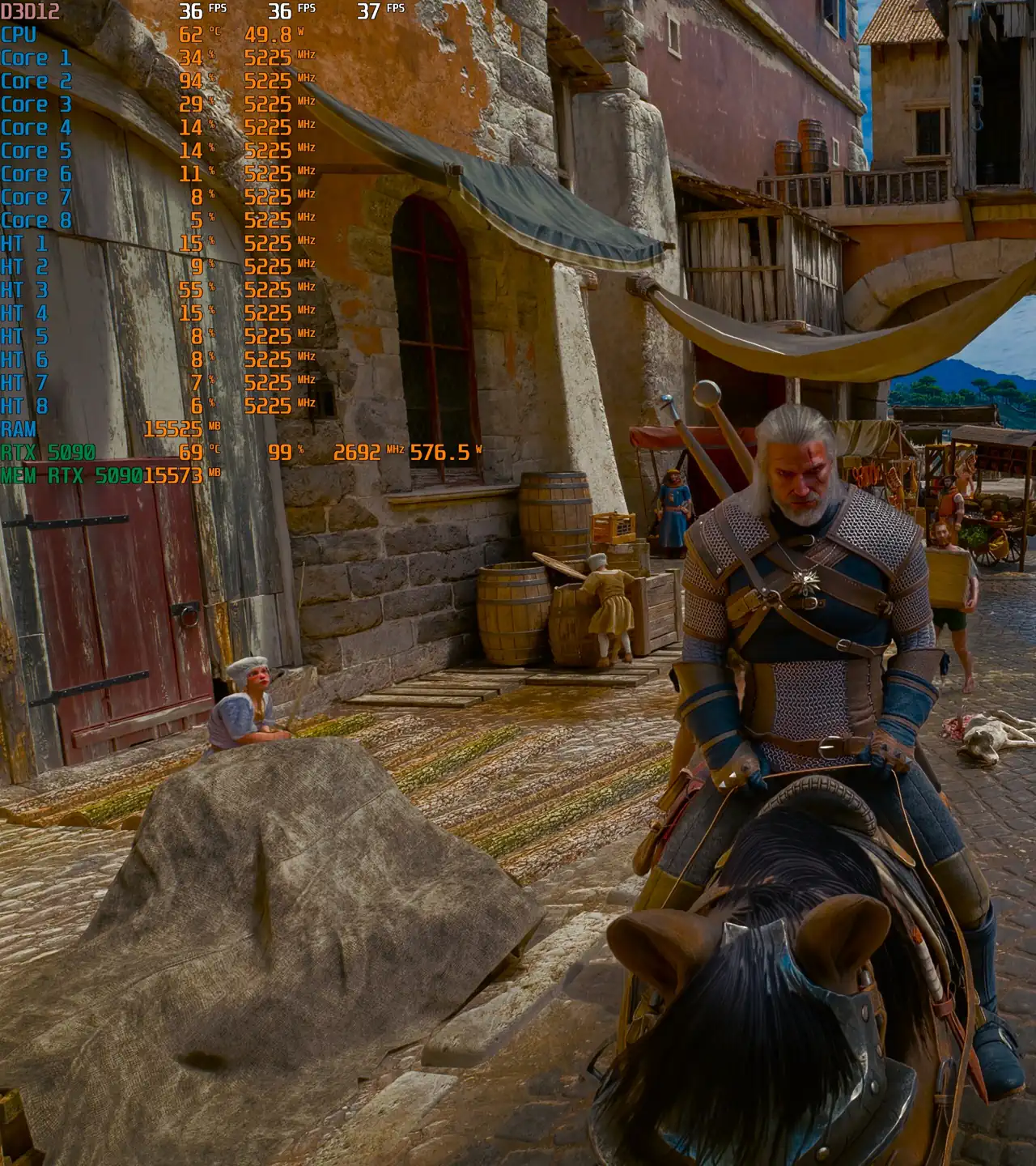
Urban scene from the benchmark with the RTX 5090 registering 36 FPS during the two-pass test. Image: GameGPU.
DLSS 5 Multipass takes RTX 5090 from 80 to 36 FPS
GameGPU's first comparison recorded 80 FPS under the reference condition. After applying the second neural pass, the counter dropped to 36 FPS.
This represents a frame rate reduction of approximately 55%. Additionally, RTX 5090 utilization went from 97% to 99% between the captures shown in this sequence.
The power consumption displayed by the overlay is also striking. The 80 FPS capture shows about 449 W, while the 36 FPS image reaches approximately 576 W. However, these figures appear in individual captures and should not be treated as a controlled measurement of average consumption.
The most consistent data is the GPU load. According to GameGPU, utilization remained between 97% and 99% in the evaluated scenes. Thus, the bottleneck was clearly concentrated on graphic processing during the experiment.
| Scene | Reference | 2 passes | Drop |
|---|---|---|---|
| Urban area | 80 FPS | 36 FPS | ~55% |
| Swamp | 78 FPS | 37 FPS | ~53% |
| Fortress | 84 FPS | 38 FPS | ~55% |
The three scenes lose more than half of their performance
The behavior was not restricted to the first section. In the swamp region, the test went from 78 to 37 FPS. In the area near the walls, the counter dropped from 84 to 38 FPS.
Calculated from the numbers published by GameGPU, the reductions are approximately 52.6% and 54.8%, respectively. Thus, all three measurements point to the same pattern: adding the second neural pass practically doubles the cost of this pipeline stage in the configuration used.
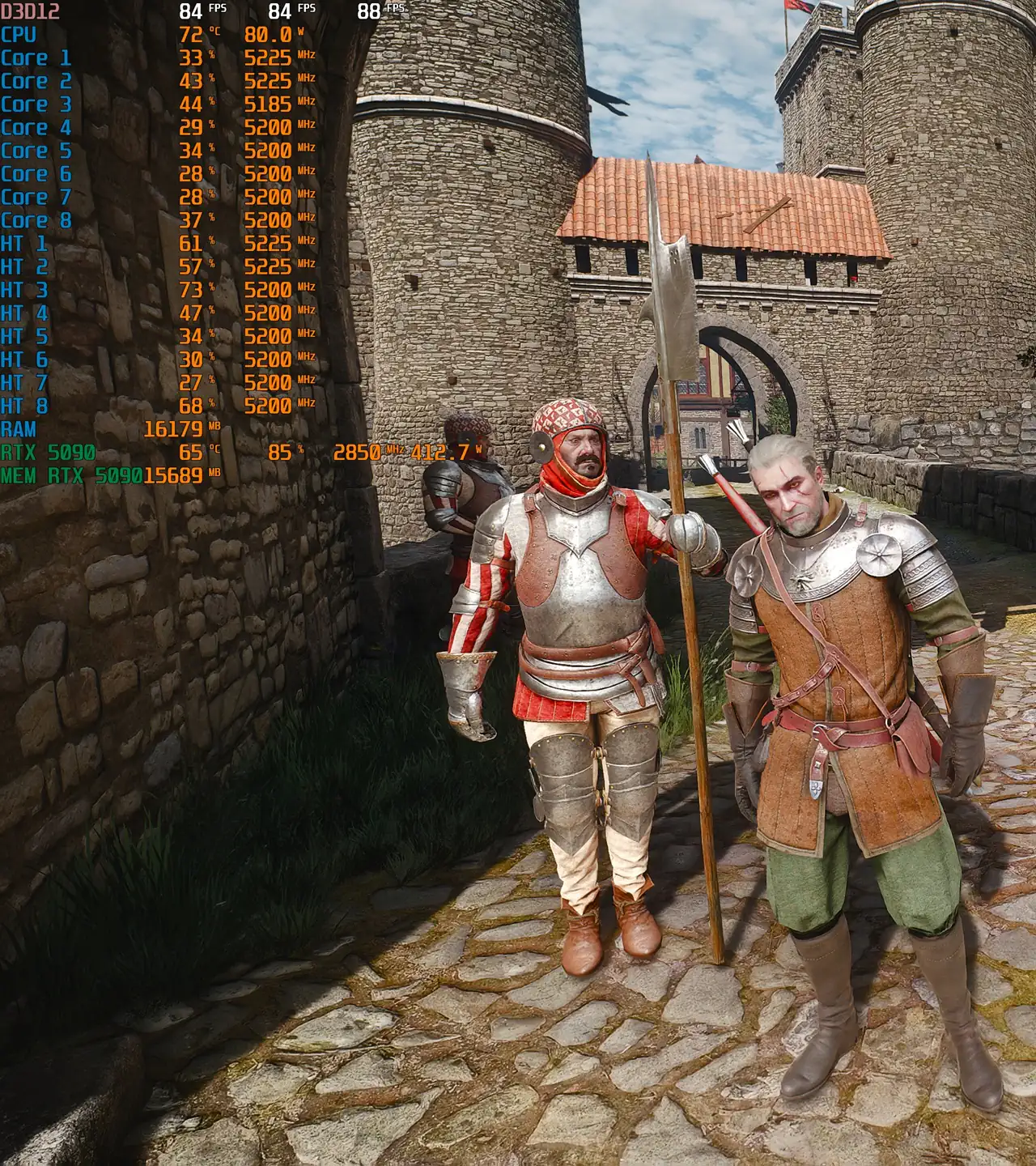
Another benchmark scene, near the walls, used in the comparison that ranged from 84 to 38 FPS. Image: GameGPU.
This is not the same test published on September 29
The new result needs to be separated from previous DLSS 5 test in The Witcher 3 published by Allves Games.
In that analysis, based on Wccftech's September 29 test, an RTX 5090 delivered approximately 50 FPS without Neural Rendering and around 35 FPS after activation. The impact was close to 30%.
Now, GameGPU evaluated a different and more aggressive configuration. The experiment runs two passes of neural processing and records losses exceeding 50% across the three presented scenes.
Therefore, the new report is not just another publication about the same measurement. It shows a second stage of the experiment: how much it costs to stack another execution of the neural model onto a pipeline that already uses Path Tracing and DLSS.
RenoDX and DLSSNP are part of the implementation
According to GameGPU, the test uses a RenoDX modification in conjunction with DLSSNP libraries. This chain replaces the standard upscaling output to insert the neural processing used in the experiment.
The game ran in 4K, with graphics settings at maximum and Path Tracing enabled. At the same time, DLSS Super Resolution was set to Ultra Performance.
This detail is important because Ultra Performance drastically reduces the internal resolution used by the traditional upscaler. Even so, the RTX 5090 continued to operate practically at its limit when the two neural passes entered the pipeline.
Therefore, the observed load cannot be explained solely by the final amount of pixels displayed. Neural Rendering itself adds a significant computational step.
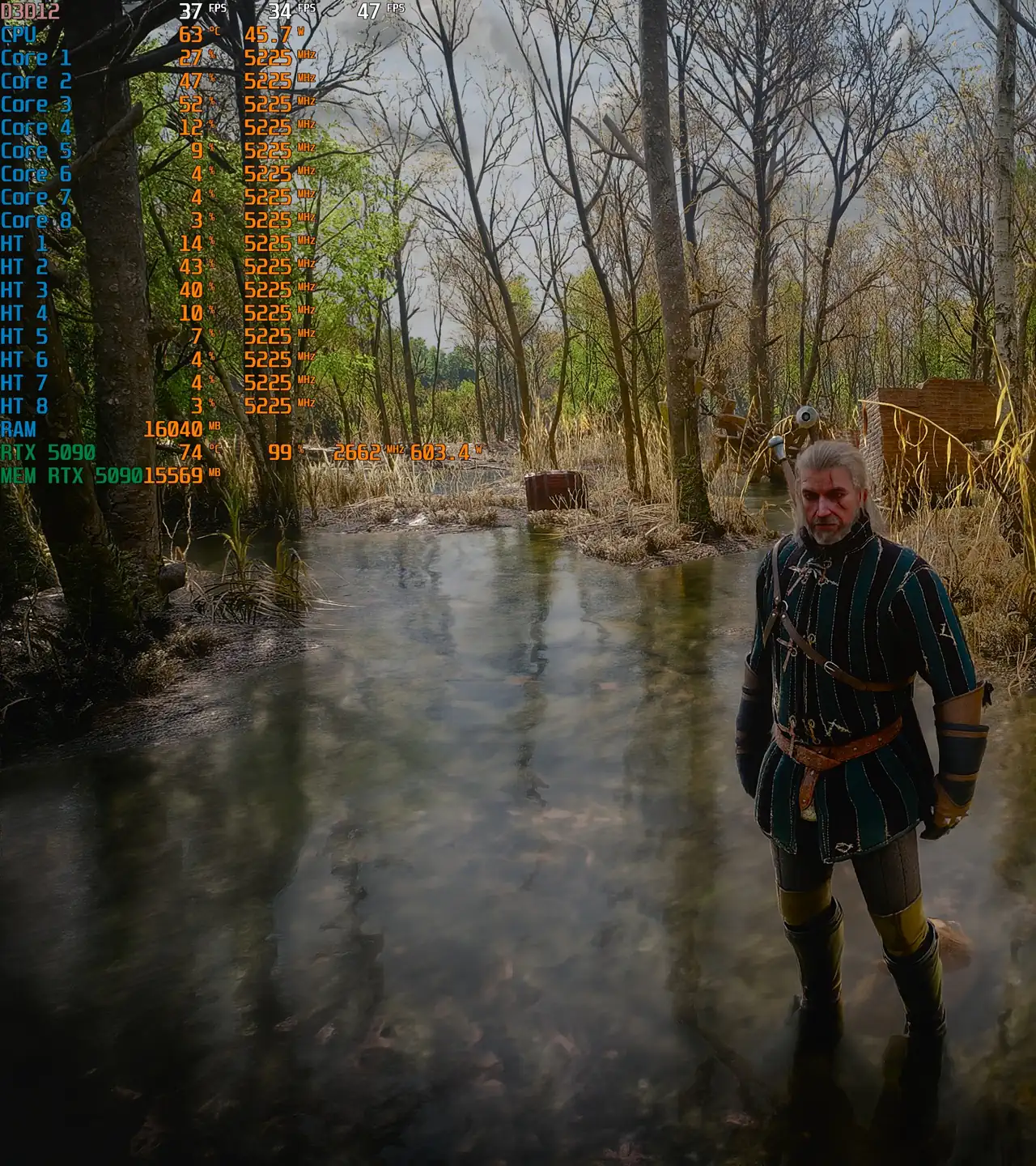
The swamp scene stayed at 37 FPS in the two-pass configuration presented by GameGPU. Image: GameGPU.
Two passes do not represent the official use of DLSS 5
It is also important to separate this experiment from the official DLSS 5 integration. NVIDIA describes its 3D-Guided Neural Rendering as a step controlled by the developer and integrated into the engine's own data.
In the official implementation, the model works with game information, including rendered frames and motion vectors. NVIDIA also describes the system as a strict pipeline from an input frame to an output frame, with controls to preserve structure, character identity, and artistic intent.
Running the model again on the previous result is a community Multipass experience. Therefore, the fact that an RTX 5090 drops to 36 FPS in this test does not mean that a game with official DLSS 5 integration will necessarily exhibit the same behavior.
The DLSS 5 Multipass guide by Allves Games has already shown that community tools allow for running multiple consecutive passes. The cost grows rapidly as new neural evaluations are added.
The result helps to measure the real price of Multipass
Until now, a good portion of the experiments with multiple passes focused on the visual difference. However, the new test puts clear numbers on the cost of a second neural evaluation on a modern game with Path Tracing.
In the best of the three measurements with two passes, the RTX 5090 reached 38 FPS. In the worst, it dropped to 36 FPS. Meanwhile, GPU utilization remained very close to 100%.
This also helps explain why community projects have been experimenting with techniques such as Pre-SR, reduced working resolution, and peripheral processing. Lowering the resolution delivered to the model can reduce the cost before the image reaches the final Super Resolution stage.
However, reducing the working resolution can also modify the amount of information available to the model. Therefore, performance and visual quality remain directly linked to the position of Neural Rendering in the pipeline.
The Witcher 3 official patch follows another path
The experiment should also not be confused with the recent official game fixes. CD Projekt RED released Patch 5.00b to restore DLSS in the Xbox Play Anywhere version for PC, a subject that Allves Games detailed separately.
This patch works with the official DLSS features available in the Remastered version. It does not add official support for DLSS 5 Neural Rendering nor does it enable two neural passes.
Thus, the new benchmark should be understood as a measurement of a specific experimental configuration: RTX 5090, 4K, maximum quality, Path Tracing, DLSS Ultra Performance, RenoDX, DLSSNP and two passes of Neural Rendering.
RTX 5090 shows the current limit of two passes
The GameGPU numbers make it clear that a second pass is a heavy operation even on NVIDIA's top-of-the-line GPU. In all three scenes, the FPS dropped by more than 50% compared to the reference condition presented by the test.
This does not make Multipass useless. On the contrary, the results help to understand how far the technique can be pushed before the processing cost starts to dominate the experience.
For image quality experiments, two or more passes remain useful as a technical tool. However, for real-time gaming, the test shows that working resolution, number of passes, and the position of Neural Rendering in the pipeline must be chosen very carefully.
Sources: GameGPU — two-pass test in The Witcher 3 Remastered | NVIDIA — DLSS 5 and 3D-Guided Neural Rendering | CD Projekt RED — The Witcher 3 Remastered release.

Pingback: AMDNR 0.3.5 leva Neural Rendering a mais jogos