

Rayman Origins Recompiled runs at 60 FPS on the Galaxy A56 with Exynos 1580, according to a new test released by the developer on September 26, 2026. The result expands the validation of the native Android port beyond the Galaxy S23 with Adreno 740 and confirms that the Vulkan renderer also works on the Xclipse 540 GPU.
Until now, the Galaxy S23 represented the main smartphone documented by the project. Now, the developer states that the latest optimizations allow the Galaxy A56 to maintain stable 60 FPS, without drops and with the resolution scale at 100%.
Furthermore, the project's technical documentation registers the Galaxy A56, model SM-A566E, with Exynos 1580 and Xclipse 540. The report also measures the first phase of the game at 60 FPS on this device.
Therefore, the novelty does not just repeat the previous test on the Galaxy S23. It shows that the port also works on a graphics platform different from the Snapdragon and Adreno combination used during initial development.

Official capture of the Android port with native Vulkan renderer and touch controls. The image comes from the Galaxy S23 and serves only as a visual reference; it does not show the test performed on the Galaxy A56. Image: Rayman Origins Recompiled/GitHub.
Galaxy A56 expands port validation on Android
The Galaxy S23 initially used by the author features an Adreno 740. In contrast, the Galaxy A56 uses the Exynos 1580 and the GPU Xclipse 540. The Samsung officially confirms the Xclipse 540 in the Exynos 1580 specifications.
Furthermore, the Rayman Origins Recompiled technical report identifies the A56 as the first device tested by the project with an Xclipse GPU. The document also highlights that the device does not use Snapdragon.
Thus, the new result tests more than just raw performance. It also verifies the project's Vulkan renderer on another GPU family and another set of drivers.
| Feature | Galaxy S23 | Galaxy A56 |
|---|---|---|
| GPU | Adreno 740 | Xclipse 540 |
| SoC | Snapdragon Platform | Exynos 1580 |
| Vulkan | 1.3 | 1.3 |
| Documented result | 60 FPS at full resolution after optimizations | 60 FPS; author reports 100% scale and no drops |
| Renderer | Native Vulkan | Native Vulkan |
According to performance report for Android, the test on the A56 recorded approximately 120 draw calls per frame. Furthermore, the renderer consumed between 0.5 and 1.0 ms of CPU per frame in the documented scenario.
At the same time, the CPU wait for GPU counter marked 0.0 ms. However, these numbers represent the section measured by the developer and not a complete game campaign.
The optimizations that brought the port to 60 FPS
The developer performed a profiling round on Android to find specific bottlenecks in the port. As a result, the project fixed issues in swapchain management, CPU and GPU synchronization, auxiliary threads, and video processing.
The swapchain was tanking performance
One of the biggest bottlenecks appeared in frame presentation via Vulkan. Android returned VK_SUBOPTIMAL_KHR, and the renderer treated this result as a signal to rebuild the swapchain.
Consequently, the program repeated expensive operations practically every frame. Among them were waiting for the GPU, destroying the swapchain, and creating new buffers.
According to the report, this behavior consumed about 47% of the main thread's time. Therefore, some levels ran between approximately 43 and 46 FPS on the Galaxy S23.
After the fix, the renderer started recreating the swapchain only in the face of errors that actually require this operation. Thus, the same scenario reached 60 FPS at full resolution.
Two frames in flight reduced CPU wait time
Another bottleneck came from the synchronization between CPU and GPU. Before the change, the CPU could wait between 3 and 8 ms per frame until the GPU finished the previous work.
To solve this, the project started keeping two frames in flight. In this way, the CPU can prepare new work while the GPU processes the previous frame.
Additionally, the report records 0.0 ms of CPU waiting for the GPU in the scenarios measured on the Galaxy S23 and Galaxy A56.
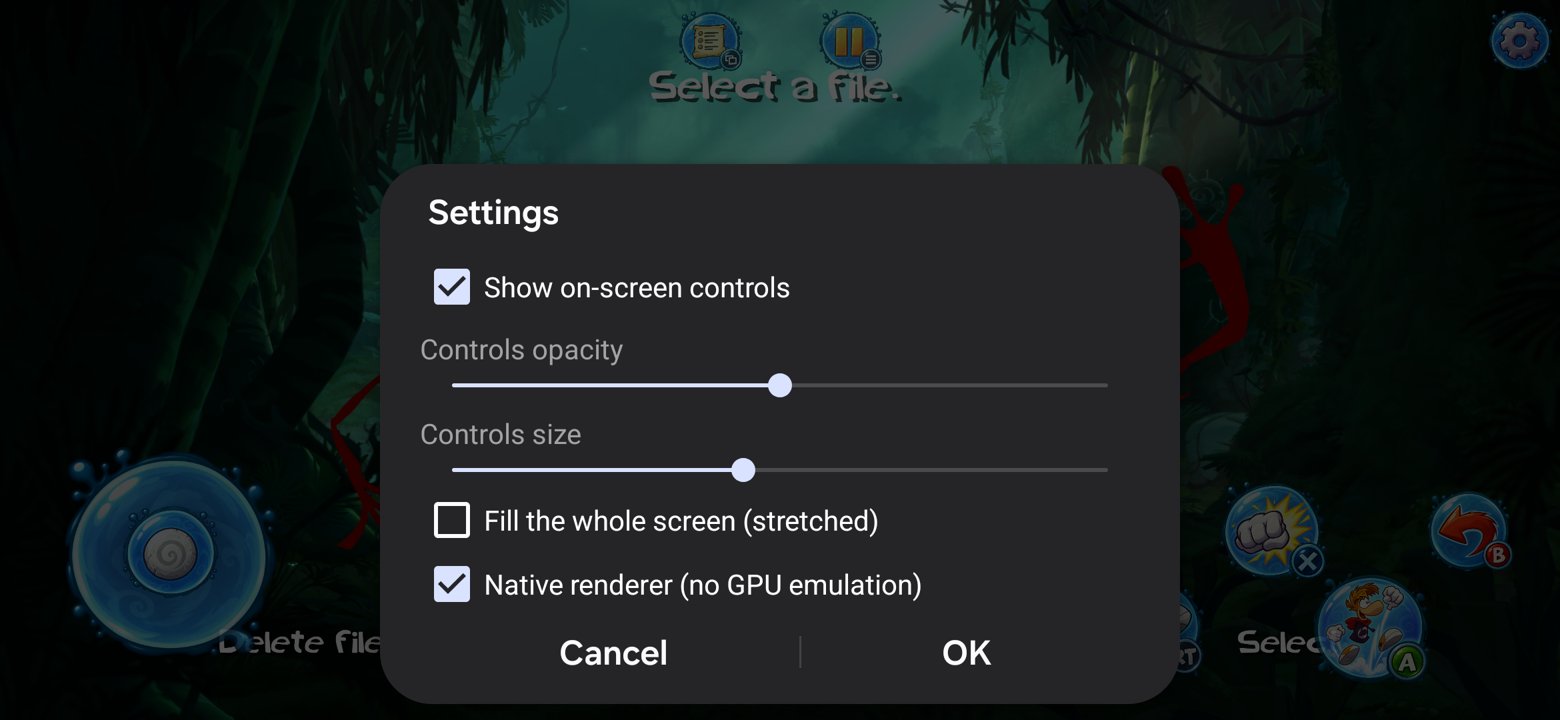
The interface offers a specific option to enable the native renderer, identified as “no GPU emulation”. This capture comes from the Galaxy S23 and does not represent the test on the Galaxy A56. Image: Rayman Origins Recompiled/GitHub.
Audio, videos, and pipelines also received adjustments
Meanwhile, the project reduced the audio worker's consumption. Previously, this thread would use about 73% of a core due to polling. After the change in the waiting mechanism, consumption dropped to approximately 7% in the documented test.
Furthermore, the project accelerated the processing of textures used in videos. The report cites a case where the decoding step dropped from about 10 ms to less than 1 ms, while the data volume sent per frame decreased fourfold.
Finally, the renderer has started using Vulkan pipeline caching and pre-warming. Thus, the project reduces momentary stutters that could reach dozens of milliseconds when an effect appeared for the first time.
How Rayman Origins recompiled works
The Rayman Origins Recompiled part of the file default.xex from the Xbox 360 version. Then, XenonRecomp transforms the executable's PowerPC code into C++.
Next, the compiler generates code for the target machine's architecture. On modern Android, this process produces native ARM64 code.
Therefore, the smartphone doesn't need to continuously interpret the Xenon CPU's PowerPC instructions like a traditional emulator would during execution.
In addition, the project uses a runtime layer to provide functions that the original software expects to find on the Xbox 360. This infrastructure takes care of components related to the kernel, XAM, memory, file system, and XMA audio.
The author also had to create specific tools for the Rayman Origins executable. The standard analyzer couldn't find the game's jump tables because the compiler rearranged instructions and added operations nop.
Therefore, the project created a detector that simulates the blocks of switch. According to the repository, this tool is able to resolve all 173 jump tables identified in the game.
The renderer sends the draw calls directly to Vulkan
During the early stages of the Android port, the project already recompiled the PowerPC code. However, the graphics still depended on the layer that replicated the behavior of the Xbox 360's Xenos GPU.
Later, the developer created a native renderer for the project. Now, this implementation intercepts the game's graphical calls and sends the work directly to Vulkan.
In addition, the project converts the shaders in advance to the format used by the modern graphics API. This way, the phone does not need to reproduce all the behavior of the Xenos GPU during normal rendering.
Thus, the current pipeline can be summarized as:
Xbox 360 PowerPC → XenonRecomp → native ARM64 code → runtime → custom renderer → Vulkan → Android GPU.
Therefore, the project does not fall into the same category as Winlator, streaming, or full Xbox 360 emulation. It is a static recompilation accompanied by a native port of the infrastructure needed to run the game.
The test also broadens graphics compatibility
The Galaxy A56 adds an important point to the validation because it uses a Xclipse 540. Meanwhile, the Galaxy S23 used by the developer employs an Adreno 740.
Thus, the port now has public evidence of working on at least two GPU families on Android. In addition, the technical report describes the A56 as a mid-range device and records Vulkan 1.3 on the device.
On the other hand, this result does not prove compatibility with the entire Exynos line or with any Xclipse GPU. Each device may also use different versions of the driver, system, and firmware.
Meanwhile, the project added a compatible path with Vulkan 1.1 for older GPUs. The Redmi 10C with Adreno 610 appears as a low-cost target in the documentation.
However, during the current verification, the report still treated this device as a development target. Therefore, the Galaxy A56 test should not be used as evidence for significantly weaker models.
What 60 FPS on the Galaxy A56 still doesn't prove
The developer claims that the Galaxy A56 achieves stable 60 FPS without drops and with the resolution scale at 100%. However, data is still lacking to turn this result into a complete campaign validation.
For example, the project has not yet published an extensive frametime analysis of the A56 across all levels. There is also no public battery of measurements for energy consumption, temperature, and battery life during long sessions.
Furthermore, the technical documentation explicitly records 60 FPS in the first level. Therefore, it would not be correct to claim that the author has already proven the same behavior throughout 100% of the game.
Even so, the new test provides important evidence. The port does not depend exclusively on the Galaxy S23 and the Adreno 740 to hit the performance target demonstrated by the developer.
GitHub already has a release, but does not offer a public APK
The project already features the release v0.3.0, published on September 25, 2026. It documents the native renderer, widescreen, video playback, and other changes.
However, the release page itself states that it does not distribute binaries. Therefore, the existence of the release does not mean that the project offers an official APK ready for installation.
Furthermore, the main code continued to progress after v0.3.0. In the check on September 26, GitHub indicated 15 commits on the main branch after the release.
The developer also explained on Reddit that some private builds intended for testing circulated prematurely. Therefore, these files do not represent an official public release.
According to the author, the plan involves providing an APK in the future where the user themselves supplies their file .xex. Meanwhile, the repository requires a legitimate copy of Rayman Origins for Xbox 360 and does not include commercial game code or assets.
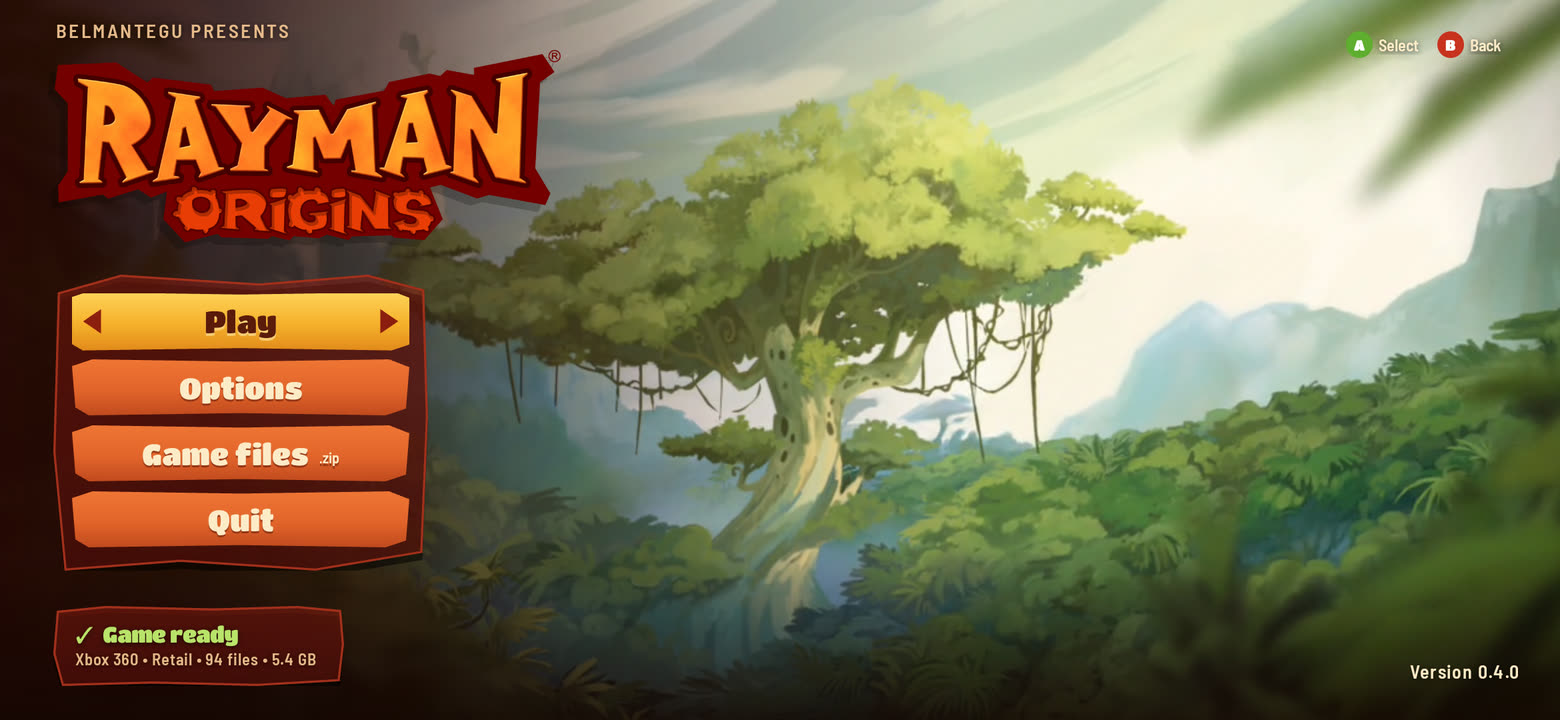
Home screen documented by the project for the Android version. The screenshot shows the port management interface on the Galaxy S23 and serves as a reference for the current state of the application. Image: Rayman Origins Recompiled/GitHub.
Why the test on the Galaxy A56 is relevant
The previous progress of Rayman Origins Recompiled demonstrated an important architectural shift: the project stopped depending on Xenos GPU emulation and started using a custom Vulkan renderer.
Now, the Galaxy A56 answers another question. The test shows that this implementation manages to move beyond the Snapdragon phone and Adreno GPU used as the primary development platform.
Furthermore, the new device occupies a different position in the market. Thus, the result broadens the project's appeal as a true Android port, rather than limiting the demonstration to a single high-end smartphone.
On the other hand, it would still be premature to extrapolate the performance to other Exynos chips, other Xclipse GPUs, or the entire Android ecosystem. Additional tests remain necessary to form a reliable compatibility matrix.
Even so, the current evidence already confirms a concrete breakthrough: the same PowerPC code recompiled for ARM64 and the same Vulkan renderer achieve 60 FPS on the Galaxy S23 and also on the Galaxy A56 with the Exynos 1580.
Sources: Rayman Origins Recompiled — GitHub; Android Performance — technical documentation; Native Renderer — technical documentation; release v0.3.0; developer post and comments on r/decomps; Samsung Semiconductor — Exynos 1580.

Pingback: Resident Evil 4 Android Roda Nativo em Galaxy S5
Pingback: Ultra Street Fighter Android roda nativo a 60 FPS