
The GTA Liberty City Stories gets a native PC port via static recompilation of the original PSP version. The new LCS Recomp project pre-converts the game's Allegrex/MIPS code into compilable code for the computer and already has a public release for Windows, widescreen configuration, and a 60 FPS target.
The project was publicly announced on September 24, 2026, and received additional coverage the following day. Unlike running Liberty City Stories on PPSSPP, LCS Recomp does not keep a PSP CPU being interpreted or dynamically recompiled during gameplay.
https://youtu.be/HobeR0kfHsAInstead, the PSPRecomp framework pre-analyzes the original executable, generates C++ code units, and uses a native runtime to execute the result on PC. The user still needs to provide the files from their own compatible copy of the game, as the project does not distribute the commercial executable or the assets of GTA: Liberty City Stories.

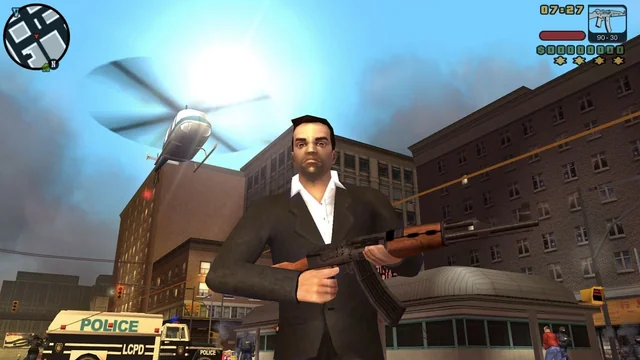
GTA: Liberty City Stories was born on the PSP in 2005. The image shows the PSP version running via PPSSPP and serves as a reference to the original software used by the recompilation; it is not a capture of LCS Recomp. Image: PPSSPP Project.
GTA Liberty City Stories receives a native version for Windows
The project is publicly available in the official LCS Recomp repository on GitHub.
The README itself defines it as a “GTA: Liberty City Stories PC port, built on PSPRecomp”.
The first public release is identified as v0.1.0 and was published on September 24th.
Beyond the source code, the project provides a compiled version that uses files provided by the user themselves.
This represents an important change for Liberty City Stories. The game received official versions for PSP, PlayStation 2, and later mobile devices, but never gained a traditional commercial version for Windows.
Until now, PC users typically resorted to emulation or community projects built through other methods.
LCS Recomp is neither PPSSPP nor PCSX2
The most important technical difference lies in how the game code reaches the PC processor.
In PPSSPP, the emulator needs to reproduce the PSP environment and execute software originally compiled for the Allegrex CPU.
The LCS Recomp follows another path.
Its core component, the PSPRecomp, was created specifically as a framework of static recompilation for PSP software.
The official documentation describes the chain clearly: the system reads an Allegrex/MIPS executable, parses the guest code, generates C++ translation units, and passes this material to a native runtime on the host.
Therefore, the chain can be summarized as follows:
PSP Allegrex/MIPS → static analysis → C++ → native compiler → PC executable + host runtime.
This transformation happens before the user starts the game.
During gameplay, the processor does not need to keep interpreting every MIPS instruction as a traditional emulator would.
Static recompilation is also different from JIT
A JIT recompiler also translates instructions from one architecture to another, but performs much of this work during execution itself.
The system identifies blocks of code, converts these blocks into instructions suitable for the host processor, and caches the result for reuse.
PSPRecomp, on the other hand, performs the main work before execution.
The known game code is pre-analyzed and transformed into C++ units that can be compiled along with the port.
Thus, the resulting program behaves much more like an application created for the host system.
This does not mean that all PSP hardware simply disappears. The runtime still needs to reproduce services, memory, graphics, audio, system calls, and behaviors that the game expected to find on the console.
However, the main part of the CPU code does not remain running on an Allegrex interpreter during gameplay.
Specific PSP version is mandatory
The project currently works with only one revision of Grand Theft Auto: Liberty City Stories.
The required version is:
- Region: United States;
- version: v1.05;
- ID: ULUS-10041.
The user needs to provide a decrypted EBOOT.ELF and the PSP_GAME folder extracted from their own compatible copy.
The repository does not include the commercial files.
The compiled version expects this data inside the folder game/. Meanwhile, those who compile the project directly use the corresponding directory within the LCS Recomp tree.
PSPRecomp also makes it clear in its own documentation that it does not include an implementation for decrypting EBOOTs and that its profiles expect files obtained by the user.

LCS Recomp works directly from the PSP version of Liberty City Stories. The handheld used an Allegrex CPU based on the MIPS architecture. Photo: Evan-Amos, public domain, via Wikimedia Commons.
LCS Recomp already comes configured for 60 FPS
One of the most interesting details appears in the project's own configuration file.
The LCSNative.ini currently included in the repository defines:
FrameRate=60
Therefore, 60 FPS is the target currently configured by the port.
Furthermore, users who tested the first version report stable performance at 60 FPS.
Coverage published on September 25 also describes support for 60 FPS and modern resolutions.
However, it is still early to turn these reports into a general benchmark.
The project did not publish a standardized battery of tests with different processors, GPUs, frametimes, or city areas.
Thus, the 60 FPS should be treated as an implemented feature already observed in initial tests, but not as a guarantee for every computer and every game situation.
Widescreen is already enabled by default
The same file LCSNative.ini confirms direct widescreen support.
The current configuration features:
Enabled=true
and:
AspectRatio=auto
This allows the presentation to adapt to the format used by the PC instead of remaining stuck to the original PSP screen.
The current renderer also uses DirectX 12 as the default backend.
The internal resolution appears configured in Desktop mode, with internal scaling 2.
In addition, the file already features options for fullscreen, upscale filter, integer scaling, MSAA, anisotropic filtering, HUD scaling, and mouse sensitivity.
These features show one of the practical advantages of turning an old game into a dedicated port: the project can expose specific settings for modern computers.
Main current settings of LCSNative.ini
| Option | Current setting |
|---|---|
| Renderer | DirectX 12 |
| Frame rate | 60 FPS |
| Widescreen | Enabled |
| Aspect ratio | Automatic |
| Internal resolution | 2× by default |
| Upscale filter | Bilinear |
The project uses Visual Studio 2022 and LLVM
Anyone intending to compile the project from the source code currently needs a Windows environment.
The README specifies Visual Studio 2022 and LLVM with clang-cl.
The repository includes its own scripts to compile and launch Liberty City Stories.
In addition, the structure contains specific directories for configuration, runtime, generated code, tests, and tools.
This reinforces that the project has already moved past the phase of a simple isolated proof that a certain piece of code can be recompiled.
There is an application built around the converted code and a release that users can already run.
There is no complete PSP emulator hidden underneath
It is important to clarify this point because recompilation projects are frequently confused with modified emulators.
PSPRecomp explicitly states that its goal is to execute the software through a native runtime instead of distributing a PSP interpreter or JIT.
This does not eliminate all translation necessary to reproduce the console.
The runtime still takes care of the functions that the original software expected from the system.
The framework features components related to ELF/PRX loading, memory, Allegrex interfaces, PSP calls, and renderer integration.
However, the CPU flow is fundamentally different from PPSSPP.
The application code has already been converted before execution.
Recompiling a game is not the same as possessing its original source code
Another important point involves the word “port”.
LCS Recomp does not possess the original source code for Liberty City Stories written by Rockstar Leeds.
PSPRecomp starts from compiled binary that exists in the PSP.
The framework needs to discover instructions, blocks, addresses, and calls and transform them into code that a modern compiler can use.
Therefore, this is a static binary recompilation, and not an official compilation of the original source code.
This distinction also separates recompilation of traditional projects from decompilation.
What is the difference between recompilation and decompilation?
In a traditional decompilation, developers try to manually reconstruct readable source code that reproduces the behavior of the original executable.
This work can take years because it involves identifying high-level functions, structures, types, algorithms, and behaviors.
In static recompilation, the goal may be different.
The framework seeks to transform the original machine code into a representation that can be compiled for another architecture, without necessarily reconstructing the entire original project in a human-readable way.
That is why a recompilation can reach native execution at a stage where traditional decompilation would still be far from reconstructing all the source code.
LCS Recomp is different from the old community ports of Liberty City Stories
Grand Theft Auto: Liberty City Stories has already received other community efforts to run natively on PC.
Previous projects resorted to reverse engineering, engine reconstruction, or conversions using bases from other Grand Theft Auto PC games.
This generated ports capable of running Liberty City Stories content, but the technical path was different.
LCS Recomp starts directly at PSP version Allegrex executable.
Consequently, behaviors and logic originating from the game's own binary form the basis of the new executable.
This difference also helps explain why recompilation requires specifically the US v1.05 revision.
PSP version is the starting point, not the mobile version
Liberty City Stories also has commercial versions for Android and iOS.
However, these versions do not participate in LCS Recomp.
The current project works specifically with the PSP files identified as ULUS-10041.
Thus, the new port is not a conversion of the Android application to Windows and also does not function as a wrapper for the mobile version.
Likewise, the current repository does not feature an Android or iOS release of LCS Recomp.
The documented target at this stage is Windows PC.

Recompilation starts from the logic and data of the PSP edition, while the PC runtime adds its own presentation layer. The image shows the original game via PPSSPP and not the new port. Image: PPSSPP Project.
60 FPS does not mean the entire game has already been validated from start to finish
The project's stage also needs to be considered.
The public repository started with only three commits recorded in this first phase.
Users are already reporting functional gameplay and stable performance at 60 FPS, while the project's own configuration uses this limit.
However, there is still no public documentation showing a complete campaign validated mission by mission.
There is also no extensive list of known regressions, deterministic comparisons, or a compatibility matrix like those found in mature emulators.
Therefore, the most appropriate description at this moment is:
public, playable and functional, but still extremely new.
Why is the recompilation of GTA LCS important for PSPRecomp?
PSPRecomp has already demonstrated that its architecture can be used to turn handheld software into native applications.
However, GTA: Liberty City Stories represents a particularly relevant case due to the game's complexity.
This is an open world with map streaming, vehicles, pedestrians, physics, audio, missions, scripts, artificial intelligence and different systems running simultaneously.
Making a title of this scale reach gameplay through the framework shows that PSPRecomp can go far beyond small technical proofs.
Furthermore, the development of runtimes, tools, and functions required for LCS can help future projects based on the same console.
PSPRecomp was born with the idea of game-specific profiles in mind
The framework's architecture was built precisely to allow each game to have its own profile.
The generic core handles Allegrex/MIPS analysis, loading, memory, and shared tools.
Meanwhile, specific behaviors, addresses, integrations, accelerated functions, and tweaks remain within the profile corresponding to the game.
This creates an important difference compared to a generic emulator.
An emulator needs to be able to correctly reproduce thousands of PSP programs.
A specific recompilation can focus its efforts on a single title.
Thus, developers can create patches and native paths specifically targeted at that game's issues.
A native port can open up space for more PC features
The initial version already demonstrates some possibilities.
The project has its own settings for widescreen, internal resolution, filtering, control, mouse, and FPS limit.
With the maturation of the runtime, this model can also facilitate improvements that would be harder to implement directly in the original PSP binary.
However, future features should not be taken for granted until developers actually implement them.
The project has not yet published a detailed roadmap for HD textures, ultrawide, full keyboard, modding, or other enhancements.
LCS Recomp does not necessarily replace PPSSPP
The existence of a recompilation does not make the traditional emulator unnecessary.
PPSSPP has over a decade of development, runs on multiple platforms, and executes a huge library of the handheld's games.
In addition, it offers various graphic and compatibility features that a newly released port might still lack.
LCS Recomp, on the other hand, focuses all its attention on a single game.
This focus can allow for deeper integration with the PC and eliminate part of the cost associated with dynamic CPU translation.
Therefore, these are different approaches for different goals.
The project already has a public release and open source
Another important point is that LCS Recomp does not exist only as a video or private demonstration.
Version v0.1.0 already appears in the GitHub releases area.
The project also makes its source code available under the MIT license, with separate notices for third-party components.
The current third-party file cites FFmpeg, used under LGPL 2.1 or later.
The PSPRecomp repository also uses the MIT license for the framework.
This makes it possible to directly follow project changes and see how the recompilation is being structured.
GTA Liberty City Stories now has a new path on PC
The first version of LCS Recomp is still far from proving that all of Liberty City Stories' missions, activities, and systems work perfectly.
Even so, the release already demonstrates concrete progress.
The PSP edition's Allegrex/MIPS code is being transformed ahead of time to run through a native PC runtime.
In addition, the project already features a functional release, DirectX 12, widescreen enabled, and a 60 FPS setting.
The community also reports that this frame rate manages to remain stable in initial tests.
Therefore, the most important point isn't simply that GTA: Liberty City Stories can be played on the computer — that was already possible through emulation and other projects.
The new development is that the PSP version's executable now serves directly as the base for a dedicated static recompilation for PC.
If the project continues to advance, Liberty City Stories could also serve as a relevant demonstration of what PSP-specific recompilation frameworks can achieve with larger and more complex games.
Sources: LCS Recomp — official GitHub repository | LCS Recomp — official releases | PSPRecomp — official static recompilation framework | r/decomps — initial launch tests and discussion | IXBT Games — coverage published on September 25.


Pingback: Super Mario Galaxy é 100% decompilado para PC
Pingback: TimeSplitters 2 recompilado já está jogável no PC
Pingback: REGTA New 3DS ganha visual de PS2 e correções de fog
Pingback: WrestleMania port nativo ganha 4 jogadores e Android
Pingback: GTA IV Android: port nativo chega ao Retroid Pocket 5 a 30 FPS