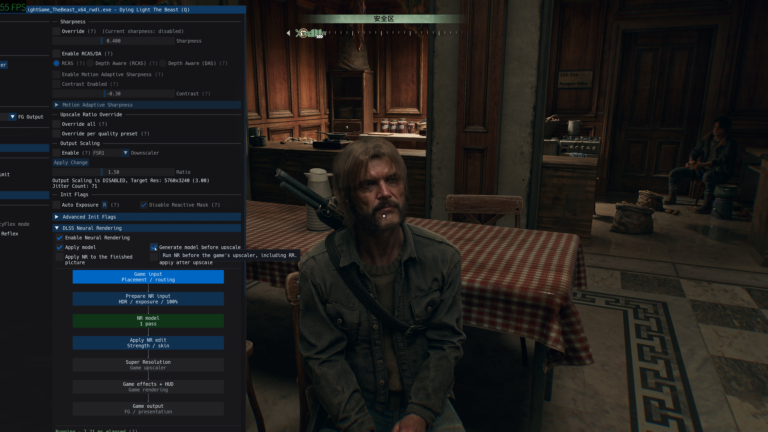
The Lossless Scaling 0.9.15, through the community project Addon Manager for Lossless Scaling, received on September 28, 2026, a specific fix for DLSS 5 Neural Rendering in HDR. The new version eliminates neon orange and cyan tones that could appear in very bright areas, reflections, and highlights. In addition, the project reduced the default temporal smoothing of Neural Rendering.
The update arrives just hours after version 0.9.14, which improved DLSS, FSR, and XeSS during fast movements. Therefore, the two releases represent a real delta over version 0.9.4 already covered by Allves Games: first the project tackled trailing, smearing, and flicker in motion; then it fixed a specific color distortion of Neural Rendering in HDR.
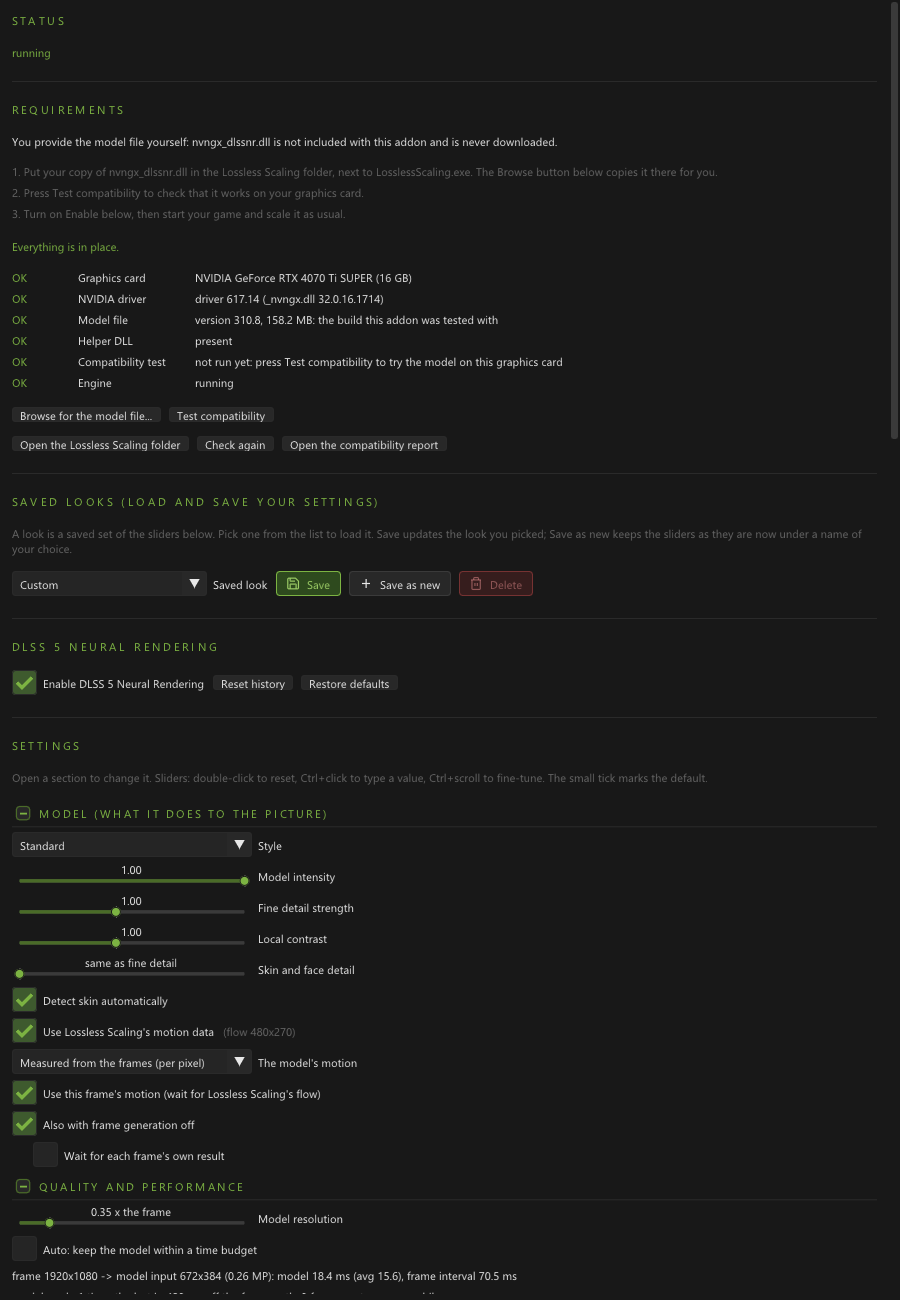
Official Neural Rendering panel in version 0.9.4, used as interface reference. The HDR fix in this article belongs to version 0.9.15. Image: Echo-Storm/GitHub.
Lossless Scaling 0.9.15 fixes neon colors in HDR
According to the official changelog, the bug came from the path used to take an HDR frame to the band where Neural Rendering works and then reconstruct the high dynamic range image. Since version 0.9.9, the project compressed highlights logarithmically before neural processing.
The problem appeared in the inverse transformation. Near the top of the curve, a small change produced by the model could grow a lot when the result returned to HDR space. Thus, when Neural Rendering increased just one color channel, that channel could return above a thousand nits and produce fluorescent orange or cyan.
Version 0.9.15 limits this contribution. Now, the change made by the model does not elevate a channel above 1.35 times SDR white, except when the original game pixel was already brighter at that point. The developer states that this behavior is close to that of version 0.9.8.
The fix applies to Windows Auto HDR, scRGB and HDR10. In addition, the project ran its host tests on the scRGB and HDR10 paths. This does not mean that all HDR games are validated, but it confirms technical testing in the two core formats used by the addon.
Temporal smoothing drops from 0.6 to 0.4
The Lossless Scaling 0.9.15 also changes the default Neural Rendering temporal smoothing value. Version 0.9.14 had set the adjustment to 0.6 for new configurations. However, the maintainer concluded that this level was excessive and reduced the default to 0.4.
Already saved configurations remain preserved. Therefore, the update does not force the new value on those who have already customized the control. The change serves as a new starting point for balancing temporal stability and motion response.
This smoothing attempts to reduce neural output flicker across frames. On the other hand, a value that is too high can increase the persistence of the previous image. Therefore, the project continues to treat stability during movement as an area under development.
Version 0.9.14 improved DLSS, FSR and XeSS in motion
Before the HDR fix, version 0.9.14 brought broader changes to the three Addon Manager upscalers. The project reduced how much temporal history is leveraged when the image moves quickly. The reason is tied to the Lossless Scaling pipeline: upscalers do not receive the same subpixel jitter that a native in-game integration usually provides.
In offline tests published by the developer with a recording of Silent Hill f, the new behavior reduced trailing and smearing during rapid camera rotation. The changelog also states that DLSS, FSR and XeSS started outperforming a simple stretch in that specific test.
The results were measured by the project itself. Therefore, they should not be generalized to other games, cards or capture conditions.
In 4K, the maintainer also measured the live cost in World of Warcraft with an RTX 4070 Ti SUPER. DLSS recorded 4.20 ms per frame, while FSR stayed between 3.3 and 3.7 ms and XeSS between 2.7 and 2.8 ms. Part of this time corresponds to the motion estimation.
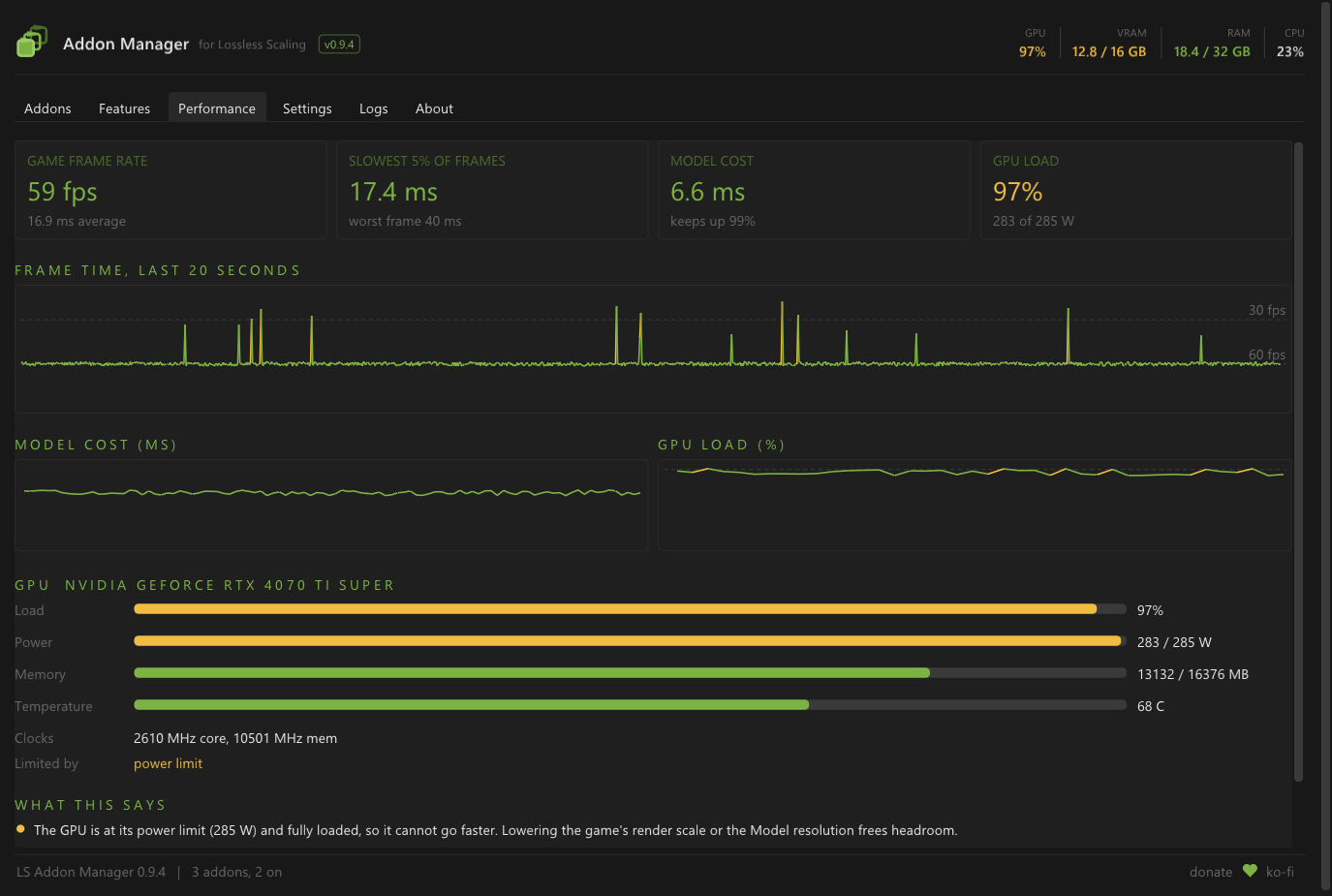
Performance tab in an official image of version 0.9.4, used as a reference for the tool that measures the cost of addons, GPU, and frametime. Image: Echo-Storm/GitHub.
DLSS at 1:1 also received a flicker fix
Version 0.9.14 also identified periodic behavior in the DLSS model L when the upscaler operated at native resolution, in a mode equivalent to DLAA. According to the project's offline analysis, the model exhibited pulses in a four-frame cycle, whereas model E did not reproduce the same pattern.
Por isso, a opção de modelo ganhou o modo AutoIn this adjustment, Addon Manager chooses the E model when working in 1:1 and keeps the L model during upscale. Anyone who had already manually chosen another model keeps their preference until selecting Auto.
Além disso, os addons de upscale ganharam uma comparação antes/depois. Assim como no Neural Rendering, o usuário pode visualizar a imagem processada, a original ou uma divisão entre as duas durante o uso.
Lossless Scaling 0.9.15 avança além da versão 0.9.4
O Allves Games já publicou uma análise da version 0.9.4 of Addon Manager for Lossless Scaling. Versions 0.9.14 and 0.9.15 do not repeat that state. On the contrary, they materially alter temporal quality and HDR processing.
Addon Manager remains a community project and is not officially part of Lossless Scaling, NVIDIA, AMD, or Intel. Neural Rendering also continues to require the user to provide their own compatible copy of the neural runtime. The project does not include or download this component.
Currently, the README documents tests in World of Warcraft: Forever, Fallout: New Vegas with Tale of Two Wastelands, Silent Hill f in HDR and Metro 2033 Redux, using an RTX 4070 Ti SUPER and Windows 11. Other games and graphics cards do not yet form a broad validation matrix.
With version 0.9.15, the immediate focus was to fix a concrete visual glitch of DLSS 5 in HDR. Meanwhile, 0.9.14 targeted the stability of upscalers and Neural Rendering itself in motion. Together, the changes make the current line technically different from version 0.9.4 covered previously.
Sources: Addon Manager for Lossless Scaling 0.9.15 — official release | Addon Manager for Lossless Scaling 0.9.14 — official release | official repository and documentation.