
GoldenEye 007 in VR received a new public release of GEVR, an unofficial project that adapts the Nintendo 64 classic for native execution on computers with virtual reality support. The version vr439, released on September 16, 2026, brings together improvements in image presentation, maintains VR movement and aiming features, and fixes issues found in previous versions.
The project uses code reconstructed from the original version of GoldenEye 007, released in 1997, and integrates virtual reality features via OpenXR. The goal is to allow players to step into the environments, move their heads, and aim with VR controllers, rather than just watching the original game on a virtual screen.
There is an important change regarding the initial announcement: the vr434 version was pulled by the developer after ROM images were accidentally included in the executable. An intermediate version, vr438, also suffered from a boot file issue for VR. Therefore, the public release currently recommended by the project is GEVR Beta vr439, available on GitHub.

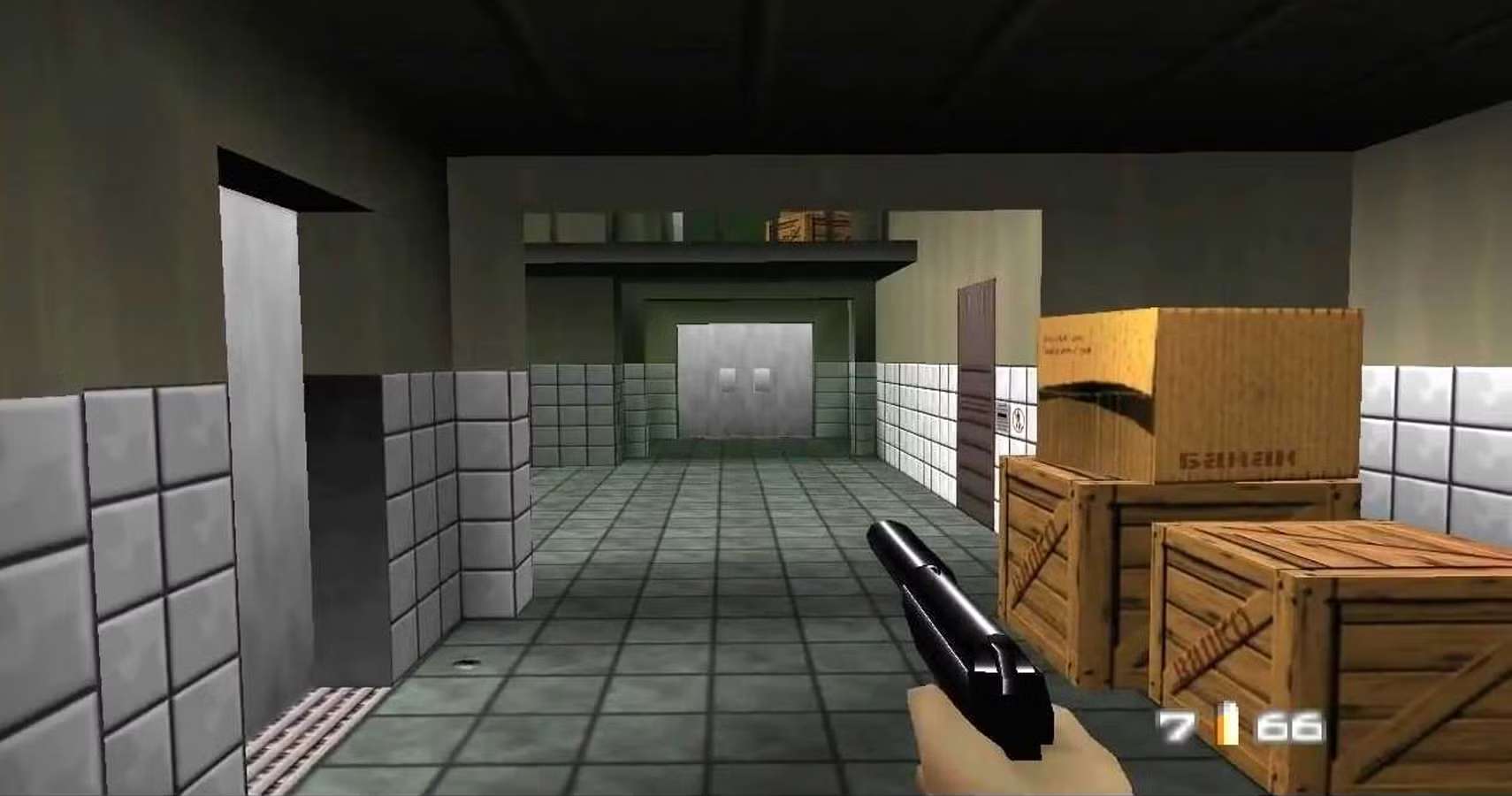
GoldenEye 007 gains a new way to explore its environments with the GEVR project. Illustrative gameplay image of the original game, not a capture of the VR version. Source: The Golden Cartridge / Medium.
What changed in the new VR version of GoldenEye 007?
The main new feature of the vr439 version is the recovery of the visual improvements that were present in the vr434 package, now in a distribution that requires the user to provide the game files themselves.
According to the official update notes, the new version maintains adjustments to the stereo image origin, in the system identified as SrcFbo and in supersampling, configured at level 3 in the VR startup profile.
Supersampling is a technique that renders the image at a higher internal resolution before presenting it on the device. Its goal is to improve visual definition, although the result and performance cost depend on the implementation and the computer used.
The update also preserves adjustments related to the sky presentation, the separation of images intended for each eye, and the player's movement space.
These changes are particularly important in virtual reality. Because each eye receives its own image, issues that might go unnoticed on a conventional screen can become more evident inside the headset.
The developer did not, however, present an independent comparison of performance or image quality that allows quantifying the gains of the vr439 version on different computers.
Why is GEVR a native port and not just an emulator with VR support?
GEVR presents itself as a PC port based on the reconstructed code of GoldenEye 007. This differentiates it from solutions that run the original game inside a Nintendo 64 emulator and add a visual layer for virtual reality.
In conventional emulation, the program reproduces the environment needed to run software developed for the original hardware. A source port, on the other hand, adapts the game's code to run on another platform.
In the case of GEVR, the project utilizes the reconstruction work of the original GoldenEye's code and integrates VR features directly into the computer version. Its official documentation describes the implementation as a native experience featuring OpenXR, stereo rendering, motion tracking, and controller-based aiming.
This does not mean that all of the Nintendo 64's behavior has been eliminated or rewritten. The port still needs to adapt systems and features of the original game to function correctly in the modern environment.
It is also important not to confuse this project with recompilation initiatives for other versions of GoldenEye 007, including work related to the Xbox 360 edition that was never commercially released. GEVR is based on the original Nintendo 64 GoldenEye and uses an approach based on reconstructed code and adaptation for PC.
How does GoldenEye 007 work in virtual reality?
The goal of GEVR is to transform the way the player interacts with the environments and combat of GoldenEye 007.
According to the feature list published by the developer, the project offers position and orientation tracking in six degrees of freedom, known as 6DoF.
This allows you to move your head to observe the environment and use the available physical space to make small movements within the virtual setting.
Weapons also receive an important adaptation: the aiming direction follows the orientation of the virtual reality controller, instead of relying exclusively on the direction the player is looking.
Among the interactions described by the project are:
- Aiming with the controller: the direction of the weapon follows the movement of the hand.
- Shooting with haptic feedback: the controllers can vibrate when a shot is fired.
- Melee combat: hand movements are used to execute strikes.
- Interaction with objects: it is possible to reach certain elements of the environment, such as doors, to interact with them.
- Menus positioned in the environment: some screens appear in a fixed virtual space, instead of remaining attached to the user's view.
The project is also working on the presentation of the game's indicators and texts to make them more readable inside the headset.
Not all features are finalized. The developer states that the full representation of James Bond's body within the experience is still part of the plans for future versions.
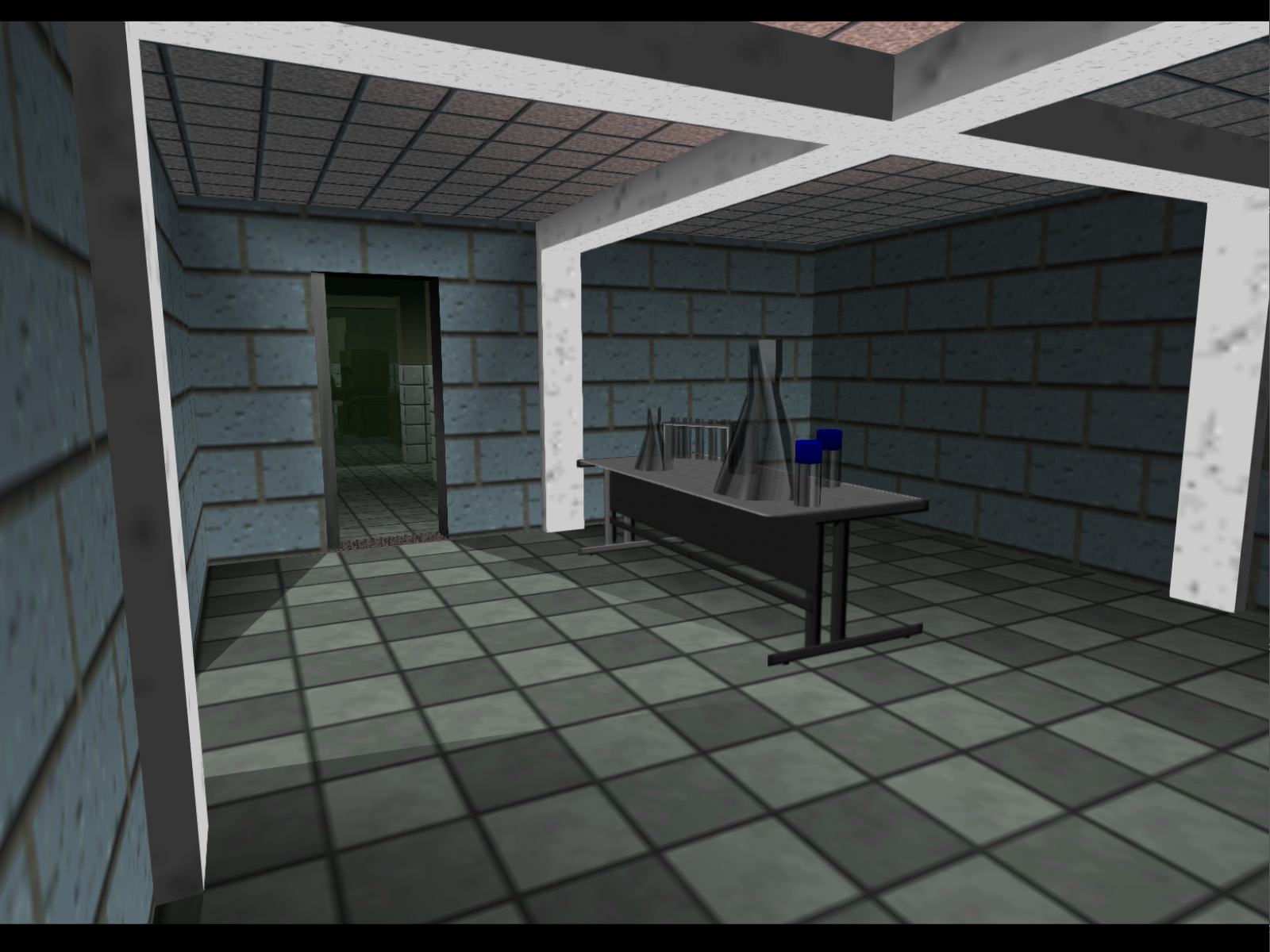
The Facility mission is among the scenarios that can be explored in GEVR. Illustrative screenshot of the original GoldenEye 007, not the VR version. Source: The GoldenEye Depot.
Which virtual reality headsets are compatible?
The vr439 version has documented tests with different virtual reality configurations for PC.
The developer reports functionality with the Pimax Crystal Super using SteamVR OpenXR and a configuration with CustomHeadsetOpenVR, as well as an alternative with native PimaxXR.
Another tested configuration uses the Meta Quest 3 connected to a computer via Virtual Desktop OpenXR.
It is important to clarify that this does not represent the release of an independent version for the Quest 3. In the documented configuration, the computer runs the game and streams the experience to the headset.
The project uses OpenXR, an interface designed to facilitate communication between applications and different virtual reality systems. Even so, using OpenXR does not automatically guarantee that all existing headsets will work correctly with this version.
Regarding the refresh rate, the developer indicates that 72 Hz, 80 Hz, and 90 Hz modes should work, with 90 Hz as the default setting. Higher frequencies, such as 120 Hz and 144 Hz, are still considered experimental.
These numbers represent headset refresh modes, not guaranteed game performance results. The documentation does not establish a proven frame rate for all hardware configurations.
What is required to play GoldenEye 007 in VR on PC?
The public GEVR package was prepared for 64-bit Windows and offers two ways to launch: one for virtual reality and another for playing on a conventional monitor.
The developer makes the file GEVR-Beta-vr439-win64.zip available on the official page for the vr439 version.
To use the experience, it is necessary to have a Windows computer, a headset with a compatible PC VR setup, and the files from your own copy of the North American version of GoldenEye 007.
The project specifically requests a ROM of the United States edition in the format .z64. The commercial game files are not included with the download.
The package includes two launchers with different purposes:
- Start-GEVR.bat: starts the virtual reality experience.
- Play-on-monitor.bat: opens the monitor version, without the need to use a headset.
On the first run, the program prepares images and other data extracted from the files provided by the user. This processing creates a cache in the folder %LOCALAPPDATA%\GEVR\cache.
According to the developer, installing a new version may trigger an automatic rebuild of this cache on the first startup. Therefore, the first load may take longer than subsequent ones.
The requirement to provide the ROM is directly related to how GEVR is distributed. Since the project does not include the commercial files for GoldenEye 007, it is up to the user to provide the data necessary to run the game.
The developer also instructs users not to upload their ROM files when opening issue reports on GitHub.
GEVR is still a beta version and has limitations
Despite its public availability, GEVR remains under development. The vr439 version should not be confused with a final release that is fully tested and free of issues.
In the update notes, the developer acknowledges the possibility of occasional crashes and describes visual glitches that still need to be fixed.
Among the examples are boxes that may appear or disappear unexpectedly in the Dam level, issues with the appearance of water, and bullet marks on glass surfaces that may be displayed in only one eye.
These flaws are especially relevant in virtual reality, as differences between the images presented to each eye can undermine the visual consistency of the experience.

The Dam mission is among the scenarios cited by the developer when documenting visual issues in the beta version. Illustrative captures of the original game, not GEVR. Source: The GoldenEye Depot.
The project also maintains a distinction between its game modes. Local split-screen multiplayer works on the monitor, but this does not mean that the current version already offers full multiplayer matches in virtual reality.
An add-on for local area network matches is in the developer's plans, while online features are slated for a later stage. Release dates for these features have not been confirmed.
So far, the available information also does not allow us to state that all missions, interactions, and headset settings function perfectly.
What does the new port represent for the preservation of GoldenEye 007?
GEVR demonstrates how source code reconstruction projects can enable experiences that go beyond simply running an old game on modern hardware.
By adapting GoldenEye 007 for PC and incorporating motion controls, position tracking, and stereo rendering, the project modifies how players interact with the game without presenting itself as a remake built from scratch.
Its current stage also shows the challenges of this type of work: in addition to adapting the original code, it is necessary to solve issues related to rendering, compatibility, controls, and file distribution.
For those who follow reverse engineering and technical game preservation, the vr439 version represents a concrete update because it reestablishes a public distribution of GEVR with the previously announced image improvements, now without including the ROM in the package.
The project remains in beta, with bug fixes and new features planned. Updates can be followed directly in the official GEVR repository.
Sources: GEVR — official release of version vr439 | GEVR — repository and documentation | GEVR — features and limitations | The GoldenEye Depot — Facility mission | The GoldenEye Depot — Dam mission.

Pingback: Port de GoldenEye 007 roda campanha completa a 60 FPS
Pingback: RetroArch em VR: OpenXR chega ao Linux com Vulkan