Native Daytona USA is already a reality on modern computers. The project daytona-arcade-recomp, by alphanu1, statically recompiles parts of SEGA's classic arcade game into portable C++ and currently offers native execution on Windows, Linux, and macOS, without using an emulation core during gameplay. The work gained attention on October 1, 2026, and continued to advance in the following days.
Allves Games video brings together this topic and other recent news about native ports.
According to the official repository, the i960 processor program and the TGP code sent by the game are recompiled into C++, while fixed hardware components such as geometry, rasterization, and tilemaps receive native implementations. MAME appears only as a test reference to compare results, rather than as an emulator embedded in the application.

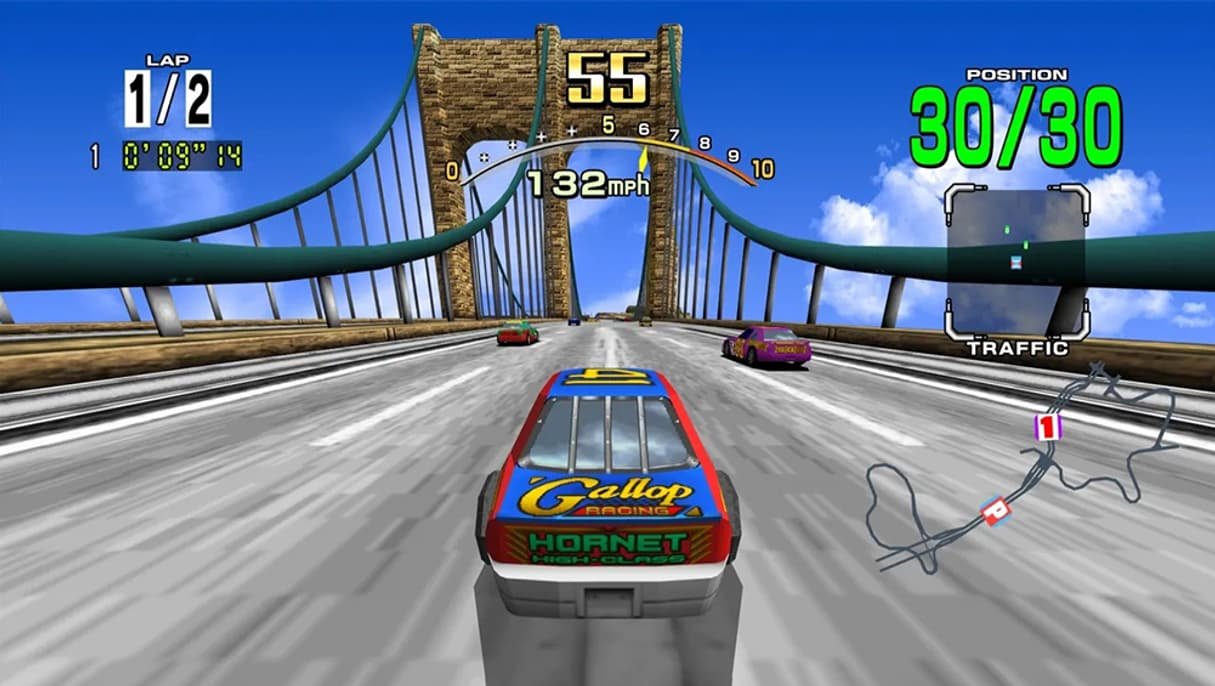
Daytona USA in a gameplay capture used as a visual reference of the original game.
How Daytona USA recompilation works
The project does not distribute the commercial game. To generate a functional build, the user must provide the data from their own legally acquired copy of Daytona USA. The documentation currently accepts the sets daytona93, corresponding to Daytona USA Deluxe '93, and daytona, referring to the 1994 arcade revision.
After that, the project's scripts analyze the data and recompile the game code for the target platform. This model is different from a traditional emulator, which reproduces the behavior of the original hardware in software at runtime. The approach is close to other preservation projects that have already appeared in Allves Games, such as MediEvilRecomp and the Metroid Prime Port.
Windows, Linux and macOS are already targets of the project
Current documentation includes instructions for Windows, Linux, and macOS. On Windows, setup can use Clang with Visual Studio tools, while Linux and macOS use their corresponding toolchains. The repository also runs automated tests across different compiler and operating system combinations.
In addition, the project features a launcher with graphics API selection. The documentation mentions Vulkan, Direct3D 12, and Metal, alongside a software renderer and a hardware renderer still treated as experimental. There are also options for supersampling, fullscreen, widescreen aspect ratios, and draw distance.
Community demonstration of the Daytona USA re-compilation project.
Modern features are still under development
The repository describes support for keyboard, gamepad, and, experimentally, steering wheels and other analog devices. There is also work on force feedback, widescreen settings, and higher-resolution rendering. These features should not be interpreted as a guarantee of flawless operation on any hardware, as development remains active.
The 1994 arcade revision also received experimental network cabinet-link support. Thus, two or more instances can be configured to replicate the logic of daisy-chained machines. This feature still requires manual configuration and remains in an experimental phase.

Another screenshot of the original Daytona USA, used solely as a visual reference of the arcade classic.
AI usage appeared in the development documentation
On October 2, Time Extension's coverage drew attention to rules present in the repository indicating the use of Anthropic's Claude as assistance during development. The material included instructions that references to the tool should not appear in commit messages, branches, or versioned files.
This detail describes the development process and does not change the technical nature of the project: the result remains a recompilation that generates native code from the game data. Still, the information is relevant because it helps separate what was produced by the developer from the automated assistance used during part of the work.
Project does not include ROMs or commercial files
The repository makes it clear that it does not contain the commercial data for Daytona USA. Therefore, compilation relies on files obtained from the user's own copy. This separation also avoids confusing the community project with an official SEGA rerelease.
Development remains active and already goes beyond the first demonstration released in early October. Because of this, features, compatibility, and procedures may continue to change rapidly. Those following the recompilation should treat the repository documentation as the most up-to-date reference for the project's state.
Sources: daytona-arcade-recomp — GitHub; Time Extension.