The project Melee Unlocked gets DLSS 5 in a separate experimental build that integrates Neural Rendering directly into the native Super Smash Bros. Melee renderer on PC. The implementation gained new public exposure on September 25, 2026, when developer Hero88go published a demonstration of the feature and the integration received technical coverage.
The difference compared to many recent experiments with older games is important. Melee Unlocked does not run Super Smash Bros. Melee via Dolphin and then apply Neural Rendering over an image capture. The project translates the game's PowerPC code in advance to C++ through static recompilation and uses its own Direct3D 12 renderer.
As a result, DLSS 5 goes directly into the port's pipeline. The experimental build adds a Neural Rendering pass after DLSS or DLAA and offers its own controls to adjust the visual output.
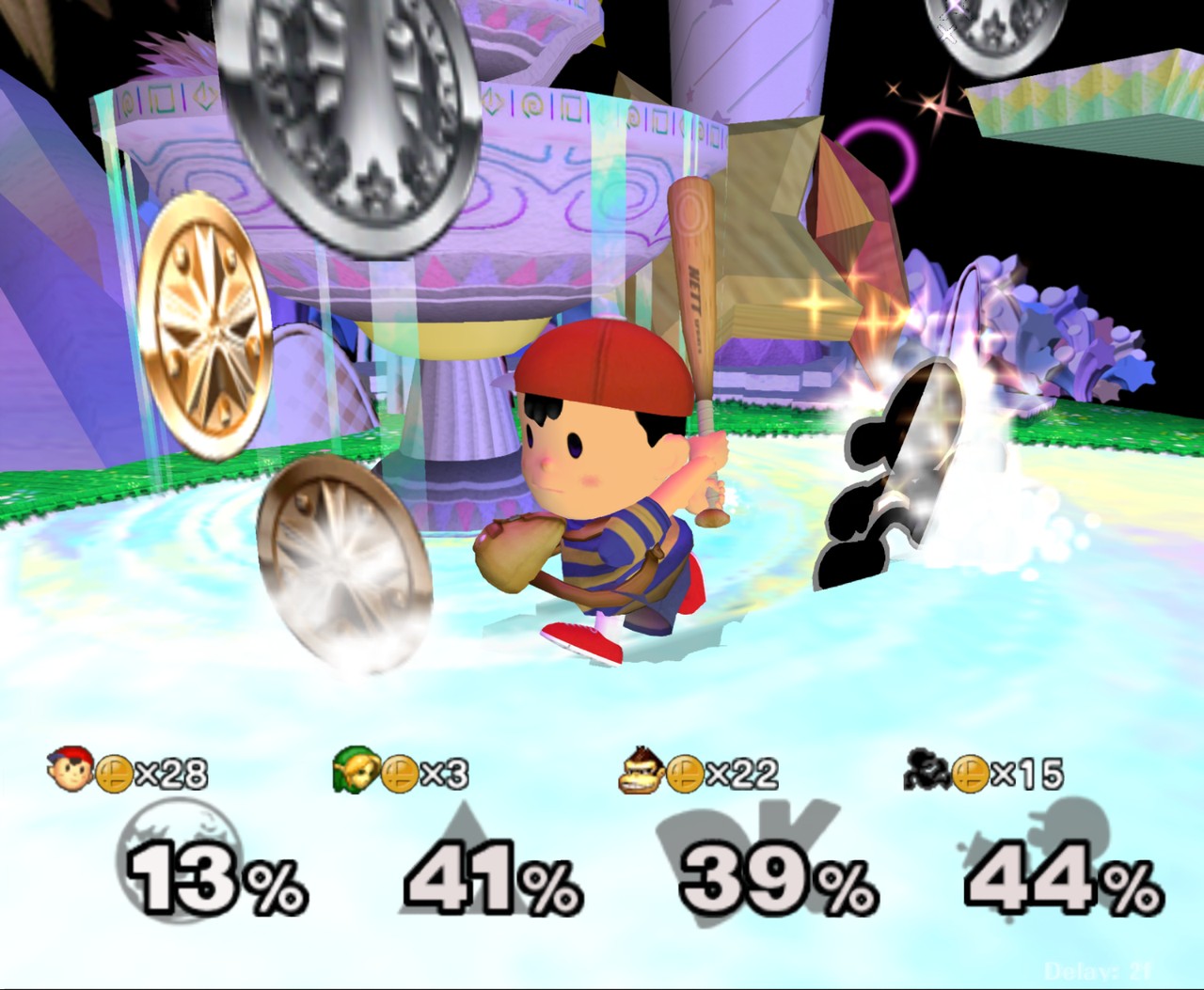
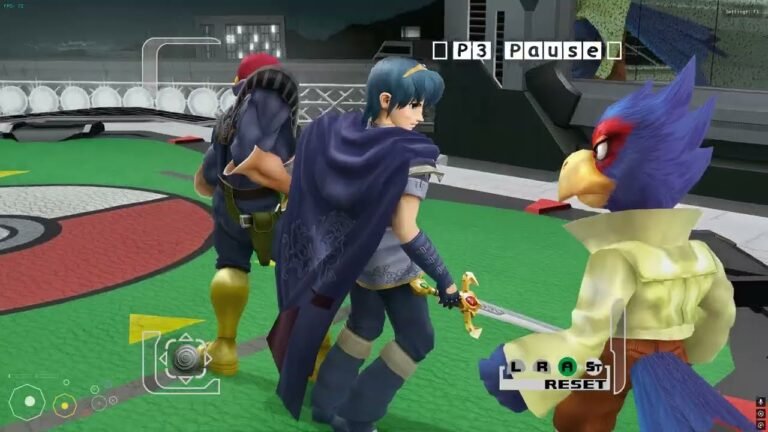
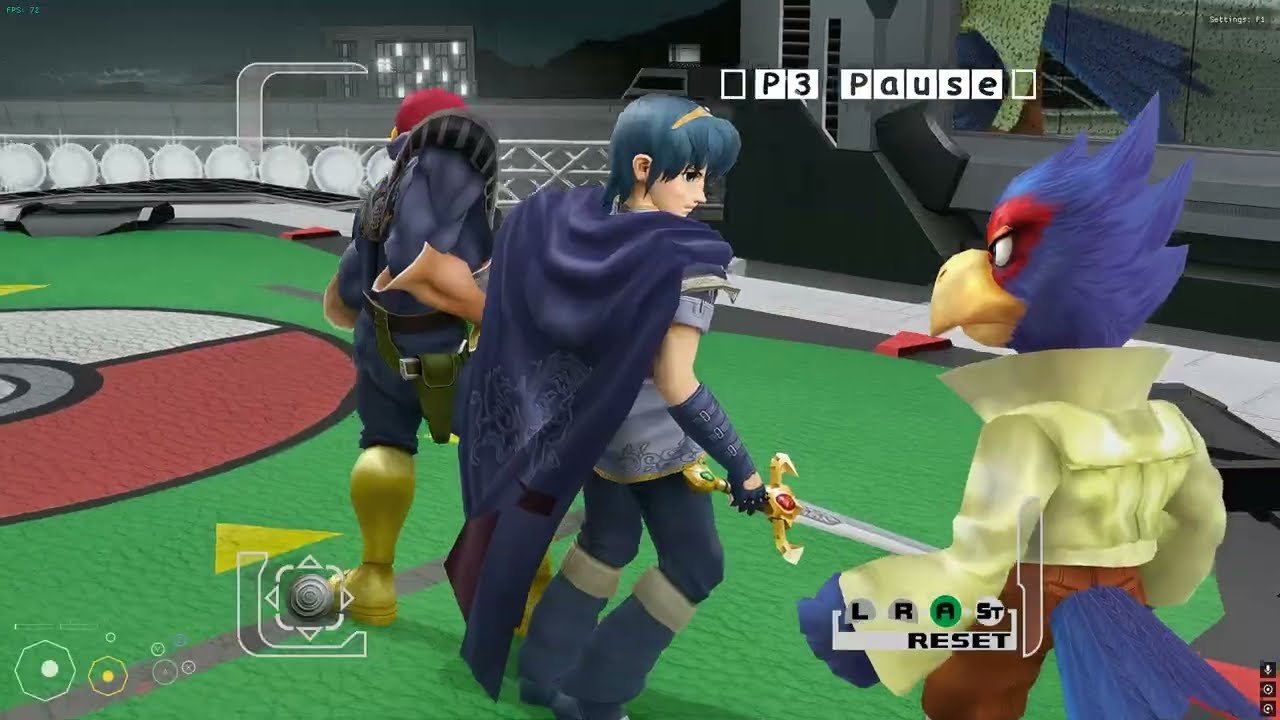
Melee Unlocked running Super Smash Bros. Melee on the port's native renderer. The official capture was produced with DLAA and does not represent the DLSS 5 mode on its own. Image: Hero88go/Melee Unlocked.
Melee Unlocked gets DLSS 5 inside the port's native renderer
The official Melee Unlocked repository documents two distinct builds.
The first is called Legacy. It represents the regular version of the game and already offers technologies such as DLSS, DLAA, NVIDIA Frame Generation, and Reflex.
The second is named DLSS 5 Experimental. It retains the features of the Legacy version, but adds an optional Neural Rendering pass over the image produced by DLSS or DLAA.
This separation doesn't just work as a graphic option within the same executable. The experimental version uses its own executables:
- melee_port_dlss5.exe
- melee_port_dlss5_compat.exe
On the other hand, the Legacy executables are compiled without this code. Therefore, selecting the experimental build in the launcher actually changes the version run by the user.
The launcher is also able to download the experimental variant when it is not yet installed. After that, the player can switch between Legacy and DLSS 5 Experimental via the build selection menu.
It is not Dolphin with ReShade applied over the image
This technical detail sets Melee Unlocked apart from various recent experiments with Neural Rendering in old games.
In an emulation-based setup, Dolphin would normally execute the GameCube's PowerPC code while an external system, such as ReShade, Feeder, or another tool, receives the image produced at the end of the pipeline.
Melee Unlocked takes another path.
Its recompiler reads the original DOL executable and translates the PowerPC code into C++ ahead of time. Then, the project compiles this code as a native Windows application.
In addition, the runtime implements functions used by the original GameCube software and adds modern systems around the game logic.
The main renderer uses Direct3D 12. Thus, the project is able to integrate modern NVIDIA technologies directly into the port's graphics pipeline.
This architecture also allows Neural Rendering to work as part of the image presentation process itself, rather than functioning merely as an external filter applied after another application finishes rendering the game.
Developer demonstrates DLSS 5 working in Super Smash Bros. Melee
Hero88go published a specific demonstration of the new implementation. The video shows Super Smash Bros. Melee with Neural Rendering enabled inside the experimental version of the port.
The public demonstration confirms that the experimental build runs Neural Rendering within the port.
Additionally, technical coverage published on September 25 describes internal controls for intensity, surface detail, lighting and tone.
Therefore, the user is not limited to a single Neural Rendering preset.
These adjustments are particularly interesting in Melee because the game's visual style differs quite a bit from the photorealistic environments that usually appear in official DLSS 5 demonstrations.
DLSS 5 comes after DLSS or DLAA
The project documentation describes Neural Rendering as an additional pass applied over the image produced by DLSS or DLAA.
This means the pipeline does not simply replace traditional DLSS Super Resolution.
First, the renderer produces and reconstructs the image using the selected setting. Then, the DLSS 5 Experimental build can run the additional neural step.
The project activates this path through specific DLSS 5 controls or the quality preset identified as Insane.
The technology can alter material responses, lighting, and visual details while using the image and scene data as a baseline.
In the case of Melee Unlocked, direct integration creates a particularly interesting situation: a game originally released for the GameCube now features a modern renderer capable of receiving graphical technology created more than two decades later.
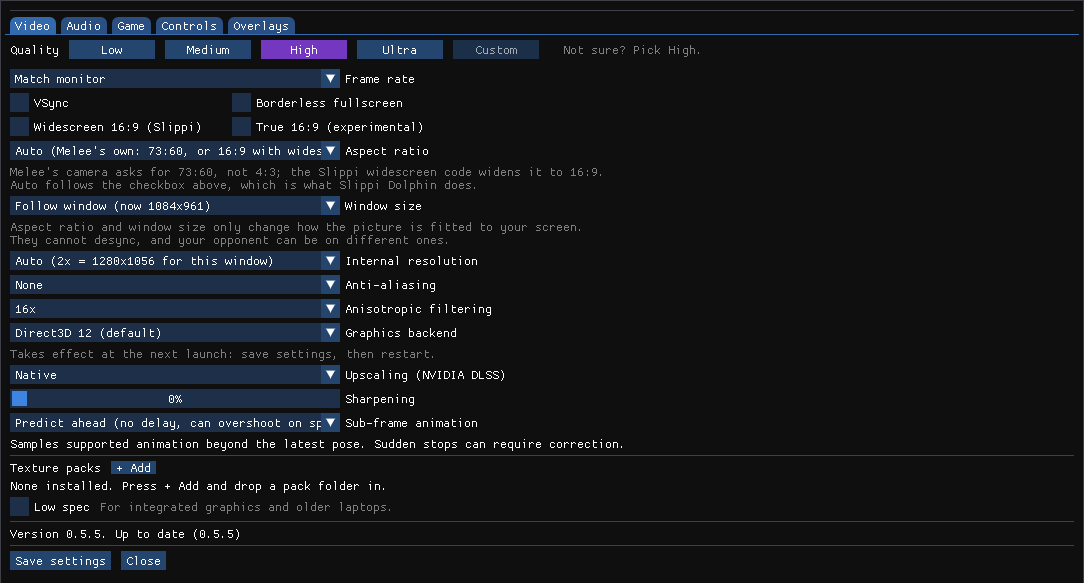
Melee Unlocked features its own video panel with Direct3D 12, DLSS, DLAA, internal resolution, filtering, and other options from the native renderer. The capture belongs to the project's regular interface. Image: Hero88go/Melee Unlocked.
The project requires nvngx_dlssnr.dll to launch Neural Rendering
Melee Unlocked does not distribute the DLSS 5 runtime file.
The experimental build looks for the file nvngx_dlssnr.dll first in the NVIDIA driver installation.
If it does not find it in that location, the program looks for the DLL alongside the executable melee_port_dlss5.exe or the compatible variant.
On the other hand, the absence of the DLL does not prevent the entire game from running.
If Neural Rendering cannot start, Melee Unlocked continues running normally and displays in the settings panel the reason why DLSS 5 was not activated.
Thus, the feature remains optional.
Experimental build targets RTX 50 Series or later GPUs
The README itself classifies DLSS 5 Experimental as intended for GeForce RTX 50 Series or newer GPUs.
Therefore, current Melee Unlocked documentation does not present RTX 20, RTX 30, or RTX 40 as officially covered hardware for this implementation.
This should not be confused with independent experiments that have already managed to run parts of Neural Rendering on older NVIDIA GPUs.
Melee Unlocked has its own integration path and its own requirements.
In addition, the project offers an alternative renderer in Direct3D 11 for machines that cannot correctly start the D3D12 backend.
However, this route has an important limitation: the D3D11 backend does not offer DLSS.
Thus, the relevant path for the neural build remains Direct3D 12.
DLSS 5 can significantly change the original visual direction of Melee
The demonstration shows that Neural Rendering can add new lighting responses, materials, and details to characters and environments.
However, the result does not simply represent a “sharper” version of the original game.
The coverage published about the demo noted that certain settings make the image darker and less vibrant. There is also visible noise in some areas.
This behavior makes Melee an especially interesting case to study Neural Rendering.
The game uses colorful characters, simple materials, and a stylized visual direction. Therefore, more realism does not automatically mean greater fidelity to the original appearance.
In certain characters or scenarios, new surface details may favor material perception. In other cases, they may alter colors, lighting, or the artistic reading that the developers originally designed.
Consequently, Melee serves as a good test to analyze the boundary between technical enhancement and a change in artistic direction.
Melee Unlocked's unlocked refresh is not Frame Generation
Another feature of the port may cause confusion with NVIDIA technologies.
The original logic of Super Smash Bros. Melee continues to run at 60 Hz.
However, Melee Unlocked manages to present the animation at higher rates, such as 120 Hz, 144 Hz, or even 200 Hz.
The project does not create these additional frames through image interpolation.
Instead, the system calculates intermediate positions using the game's own animation and physics state. This way, characters and objects can assume intermediate poses between the original simulation ticks.
Therefore, this native unlocked refresh feature is not equivalent to conventional Frame Generation.
At the same time, Melee Unlocked also offers NVIDIA Frame Generation as a separate graphics function. Thus, these are two different mechanisms that should not be grouped as if they performed the same task.
The port maintains the GameCube logic while modernizing the presentation
This division between simulation and presentation is part of the project's core architecture.
The original game code continues to determine the logic at its traditional 60 Hz pace.
Meanwhile, the runtime and native renderer add modern features, including:
- Direct3D 12 and Direct3D 11;
- DLSS and DLAA;
- Frame Generation and Reflex;
- unlocked frame rate;
- internal resolution up to 8x;
- SSAA and anisotropic filtering;
- texture packs;
- 16:9 aspect ratio;
- Slippi with online rollback.
Furthermore, the port accepts GameCube controllers, DualShock 4, DualSense, Switch Pro, box-style controller devices, and other compatible gamepads.
This transforms Melee Unlocked into something quite different from a simple recompilation that just launches the original executable on Windows.
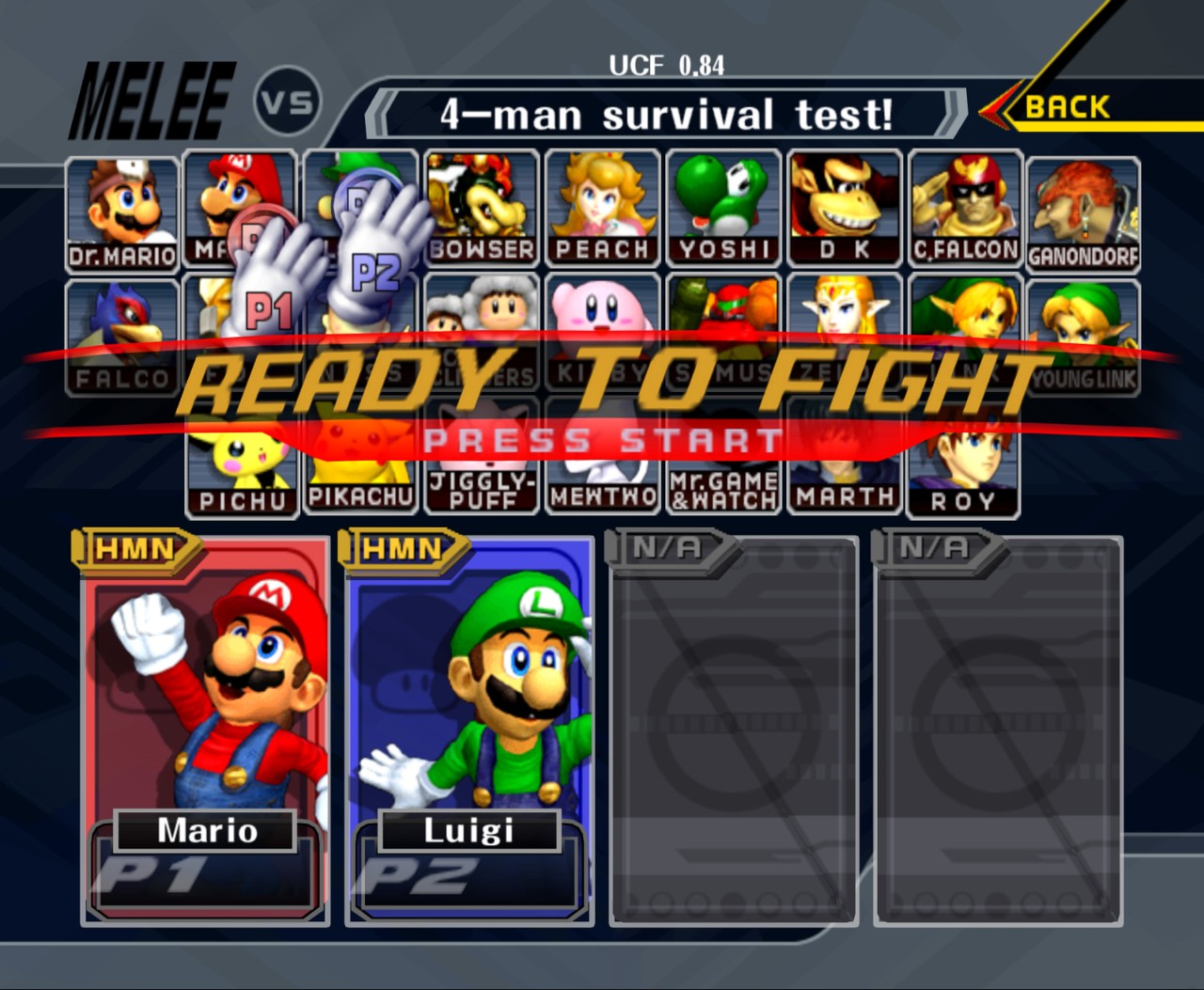
Character selection screen running via Melee Unlocked. The port recompiles the original logic and modernizes the presentation layer on Windows. Image: Hero88go/Melee Unlocked.
Slippi and rollback are also part of the native version
The project incorporates open-source Slippi code to offer online matches.
According to the documentation, Melee Unlocked players can face Slippi Dolphin users in compatible modes.
The port includes matchmaking, rollback netcode, replay recording, and the communication required for online matches.
Thus, Dolphin does not need to run the game locally when the player uses Melee Unlocked.
The user still needs a Slippi account to use the online features, but the game execution happens in the native port.
The project has tests to verify if the recompilation preserves the simulation
The repository also documents procedures for validating the recompilation.
One of the tools, validate_native.py, verifies 2,400 simulation checkpoints.
These checkpoints must show correspondence between different execution modes, including headless, hidden, threaded and authored rendering.
In addition, another test starts two local instances to run a full match through the online system.
The log must end without recording DESYNC.
These tests do not validate the visual quality of DLSS 5. However, they show that the project attempts to separate presentation improvements from the game's deterministic logic.
This distinction is important because the goal of the port is not to rewrite the competitive functioning of Melee to accommodate modern graphics.
DLSS 5 does not alter the need to own the original game
Melee Unlocked does not distribute commercial data for Super Smash Bros. Melee.
The user must provide their own image of the edition NTSC 1.02 of the game.
During compilation, the tools extract the necessary executable, translate the code, and create the native version.
The project states that no content taken from the ISO enters the public repository.
Additionally, the team makes it clear that Melee Unlocked has no official association with Nintendo, HAL Laboratory, or the Slippi team.
The DLSS 5 build numbering still appears in different ways
The current demo also presents a minor naming inconsistency.
The technical coverage describes the implementation as part of version 0.6.61.
Meanwhile, the current Melee Unlocked README identifies the public video as “v0.6.1 DLSS5 Footage”.
Since the repository does not present this difference clearly enough as two distinct formal releases, it is not safe to treat “0.6.61” as a confirmed tag based solely on the report.
The verifiable point is the existence of the build DLSS 5 Experimental, of the specific executables and the public demonstration of Neural Rendering working in the port.
There is still no reproducible performance benchmark for DLSS 5 in Melee
The demonstration allows observing the visual effect, but does not yet provide sufficient data for a complete performance analysis.
Up to this check, the project has not published a controlled comparison with FPS, frametime, VRAM consumption, and GPU utilization between Legacy and DLSS 5 Experimental.
Therefore, it is not possible to state how much Neural Rendering reduces the port's frame rate on an RTX 50 Series.
There is also no basis to directly compare this cost with external experiments done via ReShade, Feeder, or other methods.
A more useful technical test would need to keep resolution, scene, camera, and other options identical while comparing:
- Legacy with DLAA and without Neural Rendering;
- DLSS 5 Experimental at low intensity;
- DLSS 5 Experimental at intermediate intensity;
- DLSS 5 Experimental at high intensity.
In addition to FPS, it would be important to measure frametime, GPU usage, VRAM, and potential latency differences.
Why is Melee Unlocked with DLSS 5 technically relevant?
The novelty unites three areas that advanced rapidly in 2026: recompilation of old games, modern renderers for community ports, and Neural Rendering.
In many experiments, DLSS 5 only receives the final image of an old game through an external tool.
Melee Unlocked demonstrates a different possibility.
When a recompilation replaces the original hardware dependency with a modern renderer, the project can connect new technologies directly to the native pipeline.
This opens space for a more controlled integration than simply capturing an emulator's output.
At the same time, Super Smash Bros. Melee also serves as a particularly tough test for Neural Rendering. Its exaggerated visual style, colorful characters, and simple materials make it very obvious when the model adds realism that matches — or clashes with — the original art direction.
Thus, the DLSS 5 Experimental build is not merely a visual novelty. It shows how decompiled ports of older games can transform into platforms for graphic technologies that didn't even exist when these games were developed.
Sources: Melee Unlocked — repository and official documentation | Hero88go — DLSS 5 demonstration in Melee Unlocked | Wccftech — demonstration and visual analysis.