
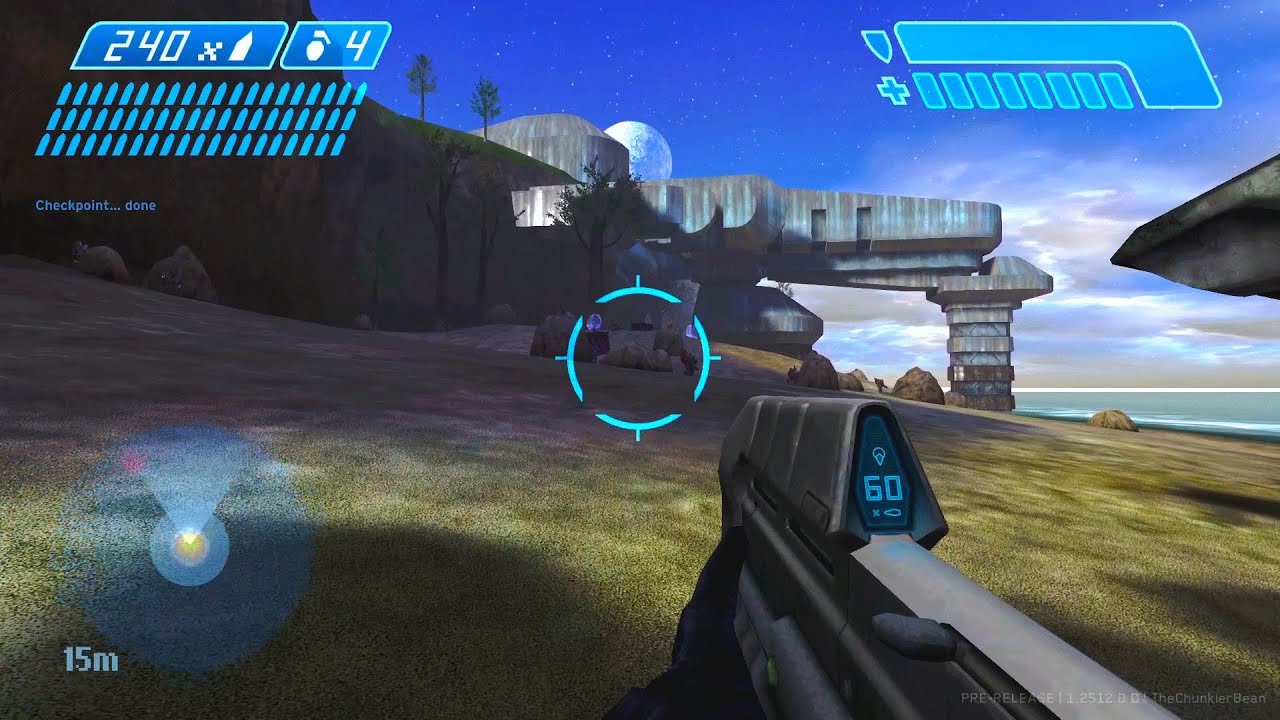
Halo CE Android received a series of builds on September 29, 2026, that significantly improved the native port of Halo: Combat Evolved based on the decompilation of the original Xbox version. The project halo-ce-universal distributes builds for Android ARM64, Windows, and Linux, while community tests already show the game reaching 60 FPS on some devices.
The results, however, still vary depending on the device, the GPU, and the build used. Some users managed to run the campaign at a speed close to the original game, while others encountered graphical glitches, startup issues, or lower performance.
The most important technical point is that this version does not emulate an Xbox. The project starts from the code reconstructed by the decompilation of Halo: Combat Evolved and creates executables adapted to modern platforms.
Halo CE Android uses native ARM64 code
The technical foundation comes from the decompilation of build 2342 of Halo: Combat Evolved for the original Xbox. The project halo-ce-universal transforms this code into versions for Windows, Linux, and Android.
On Android, the application uses AArch64 instructions and runs inside a 64-bit process. However, the original game relies on several structures with 32-bit pointers.
To preserve the layout expected by the Xbox files, the project uses an ILP32 approach over AArch64. Simply put, the CPU executes 64-bit ARM instructions while certain structures continue using 32-bit pointers and types.
This makes it possible to maintain compatibility with maps, saves, and memory structures that the original Halo expected to find on the Xbox.
The initial repercussion of the Android build showcased the halo-ce-universal APK running on real devices. Initial results still varied quite a bit across devices.
OpenGL ES 3 and SDL3 replace the Xbox environment
On mobile, the renderer uses OpenGL ES 3. Audio and input go through SDL3, while the sound backend uses AAudio on Android.
The project does not require Vulkan. Therefore, a device compatible with OpenGL ES 3 can, in principle, run the renderer, although this does not guarantee performance or the absence of bugs.
The code also features specific widescreen adaptations. The 3D field of view expands horizontally, while the HUD remains close to the screen edges. Menus and certain screens remain centered in the original aspect ratio.
The documentation also states that the application works exclusively on 64-bit devices. The Pixel 9 Pro XL appears as an example of a compatible device with this execution model.
Recent builds already reach 60 FPS on some devices
Initial public tests showed inconsistent results. Early builds exhibited reduced performance and crashes on certain devices.
By September 29, users began reporting a significant improvement. A test with the Snapdragon 8 Gen 2 showed stable 60 FPS during the experience presented by the author.
Another user published Halo: Combat Evolved running at 60 FPS on a device equipped with a MediaTek Helio G99. These results are individual community tests, not benchmarks controlled by the developer.
Consequently, they do not mean that any device with the same SoC will deliver identical performance. Drivers, Android version, build used, and GPU behavior can also alter the result.
Community test of a recent Halo CE Android build. The author reports 60 FPS on a Snapdragon 8 Gen 2; the result does not represent an official benchmark.
Android 9 is the documented minimum requirement
Official documentation establishes Android 9, API 28, as the minimum version. The current build targets ARM64 and uses the ABI arm64-v8a.
There is also a limitation related to memory page size. Kernels configured with 16 KB pages do not currently work, because the original Xbox memory uses 4 KB pages.
The application also needs to reserve a specific region of the address space to reproduce the memory map used by the game. On devices where this region is not available, the port may fail to load the game image.
These differences help explain why a given APK might work perfectly on one device and fail on another that is seemingly more powerful.
Halo CE Android does not yet have touch controls in the main project
The halo-ce-universal main still does not accept touch controls. The documentation recommends an Android-recognized gamepad or a keyboard.
The DualSense connected via Bluetooth appears as the official example. The port also offers vibration and utilizes the additional controls for local split-screen multiplayer.
The first connected controller represents player 1. Other gamepads can take on players 2, 3, and 4 in compatible modes.
This absence of touch is important because independent forks with their own overlays have started to emerge. These forks should not be confused with the official features of the main branch.
Another community test shows Halo CE running on Android with a MediaTek Helio G99. This individual result does not guarantee the same performance on all devices.
The application itself extracts the game files
The project does not distribute Halo: Combat Evolved nor Microsoft's commercial files. To use the port, the player must provide the data from their own legally acquired copy of the Xbox version.
On the first launch, the app opens Android's file selector and allows choosing a disk image in ISO or XISO format. Then, it automatically extracts the folder maps to the application directory.
The documentation estimates approximately 1.8 GB of data after extraction. After the process finishes, the complete disk image does not need to remain stored on the device.
Saves, configurations, and logs are kept inside the application data folder. The port can also update the APK when a new compatible release appears.
System Link connects Android, Windows, and Linux
Multiplayer also received important changes. halo-ce-universal allows System Link matches between Android, Windows, and Linux machines.
The project documents a limit of up to 128 players across up to 128 devices. There is also a link invitation system halo:// for online matches.
On Android, opening this type of link can launch the application and automatically forward the data required to join the match.
This limit of 128 players represents a capacity implemented by the project. It should not be interpreted as a guarantee of a stable match with 128 participants across any hardware and network combination.
Bink videos do not work yet
The port still has limitations. The Bink videos used by the original game are not available and are skipped during execution.
There are also reports of missing geometry, broken textures, and loading failures on certain builds and devices. Development is moving fast, so behavior may change between consecutive versions.
Therefore, Halo CE Android should continue to be treated as a native port in development, rather than a stable and definitive version for all mobile phones.
Separate fork already adds touch controls
On October 1, 2026, an independent fork also emerged called HaloCE-Android-AAOS. It derives from existing work, but adds its own changes specifically aimed at Android devices.
The developer integrated the RetroTouch library, which adds a virtual joystick, camera area, and configurable on-screen buttons. The controls can automatically disappear when the app detects a physical gamepad.
This fork also creates a variant for Android Automotive OS. The developer demonstrated the implementation on a Renault 5 equipped with AAOS.
In addition, the fork reports fixes for missing walls and geometries, fullscreen adjustments, audio on Android Automotive, and an option to restore the original 30 FPS mode.
Independent fork released on October 1st adds RetroTouch, graphical fixes, and a build for Android Automotive OS. These features do not belong to the main halo-ce-universal.
iOS does not yet have an equivalent public version
Despite the progress on Android, the main project does not currently distribute an IPA for iPhone or iPad. Nor is there an equivalent release via the App Store or TestFlight.
The main repository maintains work related to other platforms, including proposals for macOS, but this does not automatically turn these branches into stable or officially distributed versions.
Therefore, Android ARM64 remains the public and documented mobile implementation of halo-ce-universal at this time.
Halo CE Android is still evolving rapidly
The current state shows how the decompilation of Halo: Combat Evolved has opened up paths that would be difficult with traditional emulation. The same reconstructed code now powers builds for Windows, Linux, and Android, as well as experimental forks aimed at new platforms.
On Android, the combination of ARM64, OpenGL ES 3, and SDL3 already makes it possible to play the campaign on real hardware. Community tests also show that 60 FPS are possible on certain devices, although results remain heavily dependent on the build and the device.
At the same time, new variants are already experimenting with touch, Android Automotive and specific fixes for mobile GPUs. Development continues rapidly, so new builds can change compatibility, performance and features in a short time.
Sources: halo-ce-universal — official repository; official Android build documentation; test on Snapdragon 8 Gen 2; test on MediaTek Helio G99; HaloCE-Android-AAOS; RetroTouch.


Pingback: Halo no 3DS ganha port com campanha e multiplayer local
Pingback: Halo no Anbernic RG35XX H ganha multiplayer online e muOS
Pingback: Halo no iPhone ganha multiplayer com jogadores de navegador
Pingback: Halo: Combat Evolved no Mac: multiplayer e melhorias