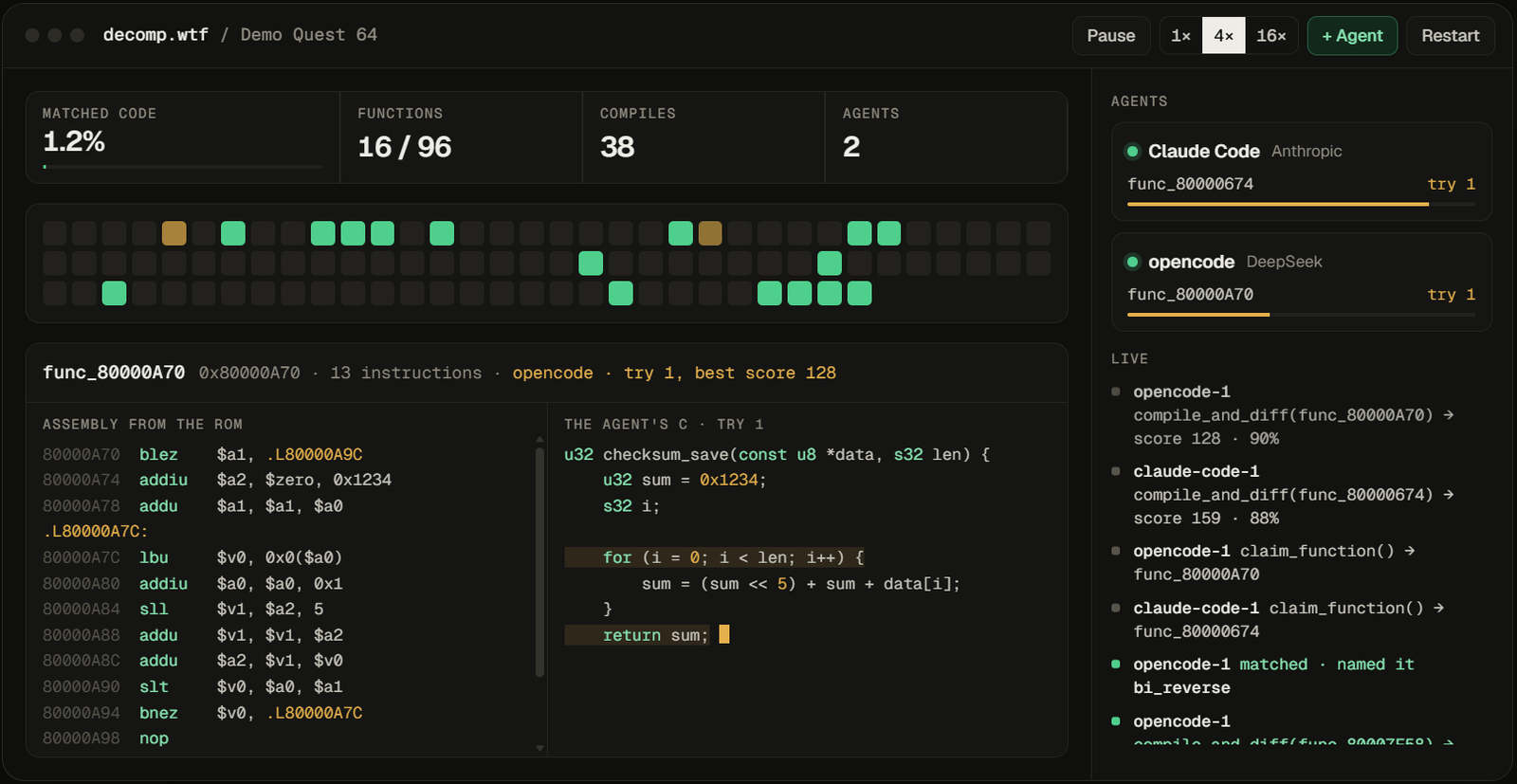
On October 14, 2026, the developer introduced decomp.wtf, a local tool that connects artificial intelligence agents to game decompilation projects. Thus, the program does not accept C code just because it compiles: it compares the result with the original binary, byte by byte.
The official repository on GitHub describes the process and makes the source code available under the MIT license. Furthermore, in the query carried out on October 14, the configuration file already indicated version 0.9.3 of the Python package decompnet; this does not equate to an independent executable version distributed via GitHub Releases.
How decomp.wtf works
First, the tool analyzes the game copy provided by the user itself and separates functions and symbols using tools like splat and spimdisasm. Next, agents like Claude Code, Codex, Gemini CLI, or opencode can attempt to reconstruct functions in C or C++.

Official simulation of decomp.wtf with the demo game included in the project. Source: i12bp8/decomp.wtf, GitHub.
Then, the system compiles each attempt with the compiler corresponding to the game and checks if the generated bytes match the original. When the match fails, the agent receives the differences to continue the work. Therefore, the feature does not guarantee that any game will be automatically decompiled.
Which consoles and systems are mentioned?
To begin with, the documentation lists Nintendo 64, PlayStation 1 and 2, GameCube, Wii, Game Boy Advance, and Nintendo DS for projects started from scratch. In addition, it allows continuing public decompilations from other platforms, but this option depends on the structure and files of each project.
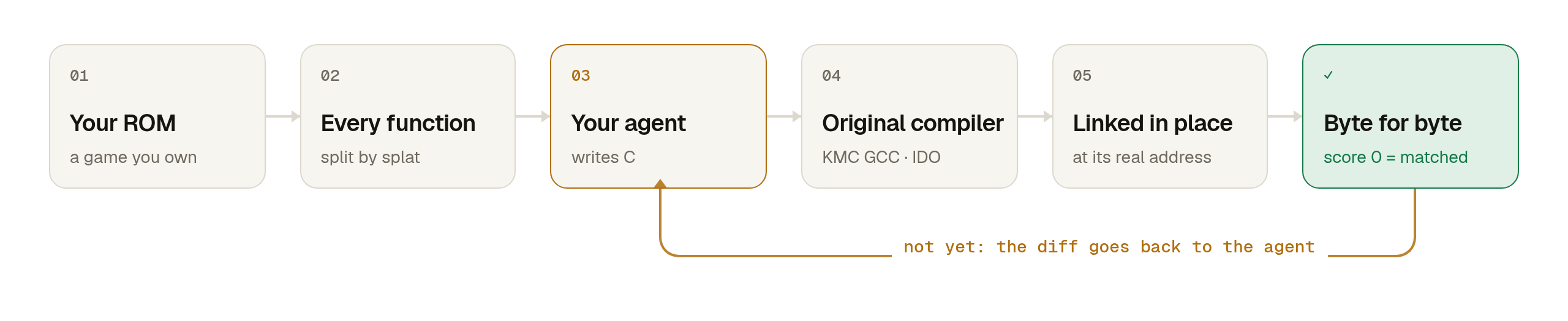
Technical flow of decompilation, from reading the game to verifying the compiled code. Source: official decomp.wtf documentation on GitHub.
Furthermore, the project offers a local browser interface and support for user collaboration. The program runs on Windows, Linux, and macOS, with Python 3.12 or higher as a package requirement. Some tools and compilers have specific system restrictions.
Installation and current limitations
In turn, the README provides installation scripts for Windows (PowerShell), Linux, and macOS, as well as integration via the command decomp connect. However, these scripts are not ready-to-use EXE files. Before running them, it is advisable to review the code and requirements in official installation guide. We do not perform installation or independent testing.
Before starting, the user needs to provide their own legitimate copy of the game. Additionally, the AI agent may require an account, subscription, or usage fee. For this reason, decomp.wtf does not distribute ROMs, does not replace human review work, and does not automatically turn a decompilation into a playable port.
In this context, the advancement connects to the growth of code reconstruction projects, as shown by our article on the recomp.board catalog and decompilation progress. Similarly, another example of specific effort is the Digimon World DS reconstruction project.
In short, the release introduces a development tool, not new ready-to-play PC games. Our conference consulted the documentation and the code published by the author, but did not include independent benchmarking.
Sources: decomp.wtf repository and README; package version; public presentation by the author on Reddit embedded above.