
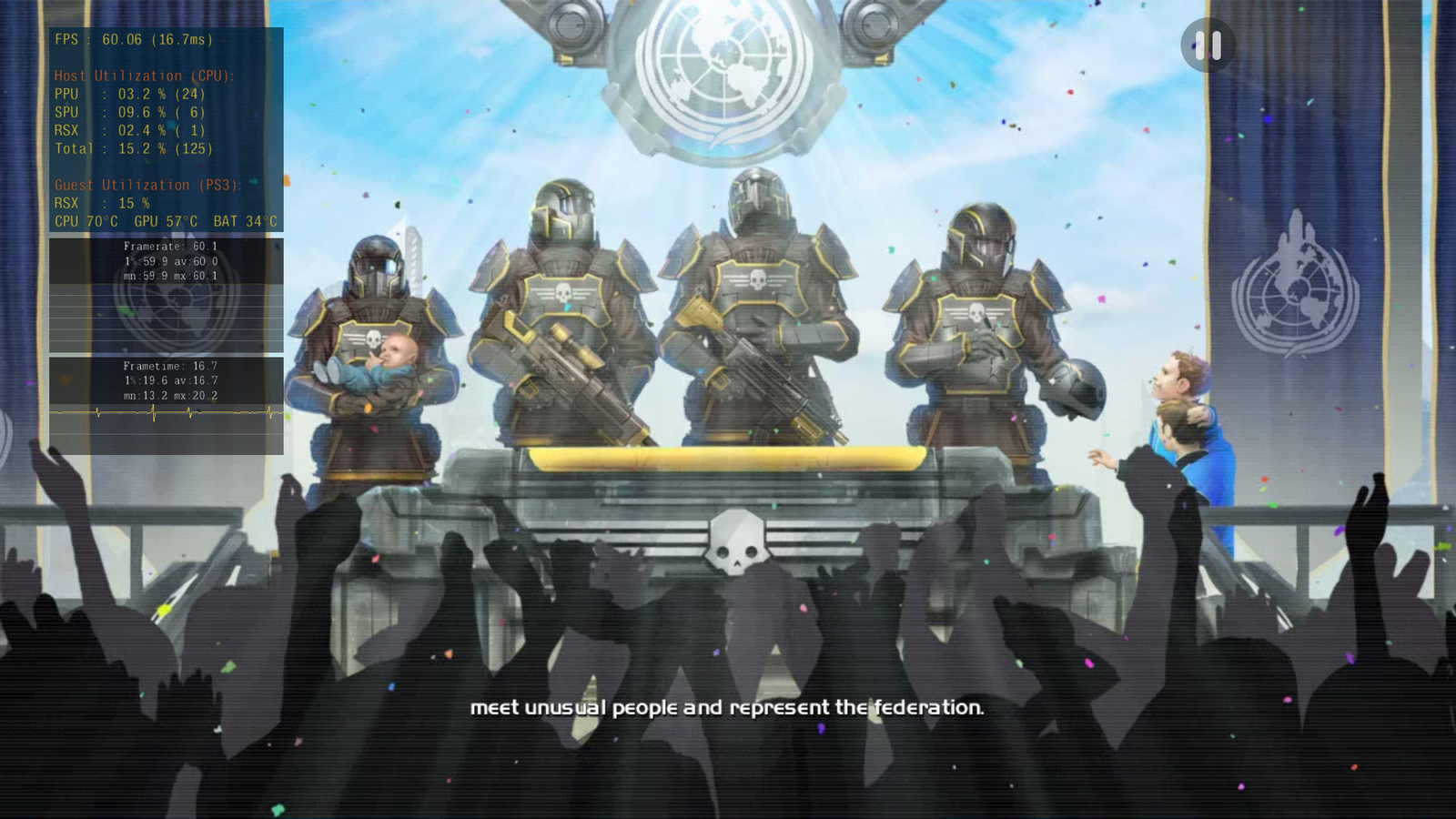
The ARMSX3 1.0 improves PS3 emulation on Android with the largest set of changes released by the project so far. The update makes games like Helldivers and Race the Sun reach 60 FPS on the AYN Odin 3, adds SIXAXIS motion support, incorporates new touchscreen controls, and allows using real PlayStation 3 themes — including animated 3D scenes — directly in the emulator's library.
Version 1.0 was officially released on September 24, 2026. On September 25, the project received minor subsequent hotfixes. Therefore, the major technical leap is in 1.0, while the following versions fix specific issues discovered right after launch.
The change shows a considerable evolution compared to August, when the developers themselves still treated ARMSX3 as a proof of concept based on RPCS3's ARM64 work. At that time, Skate 3 was cited at approximately 20 to 30 FPS on a Snapdragon 8 Gen 2. Now, some commercial games already reach their respective 30 or 60 FPS targets on high-performance Android hardware.
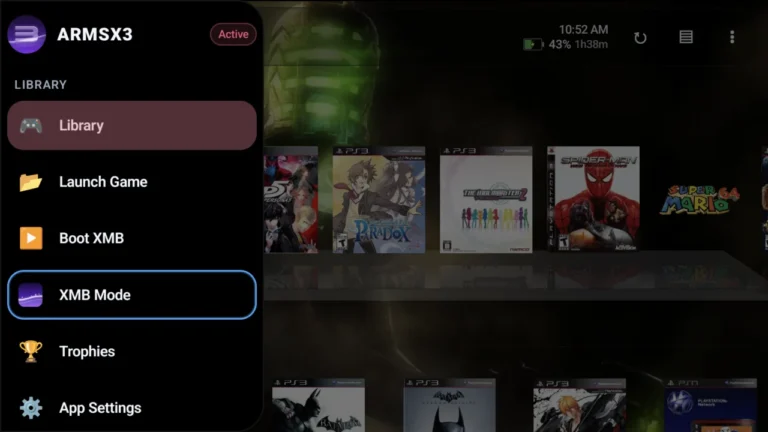
ARMSX3 1.0 now plays real PlayStation 3 themes directly in the library. Official image published in the release notes: ARMSX3.
ARMSX3 1.0 brings Helldivers to 60 FPS on Odin 3
One of the main changes in the official release of ARMSX3 involves the PPU recompiler.
Helldivers and Don't Starve: Giant Edition faced an issue related to the overflow flag in a family of math instructions. According to the developers, the same behavior also existed in the upstream RPCS3 code.
Because of this, the RPCS3 compatibility base had directed these games to the interpreter, which delivers considerably lower performance than the recompiler.
ARMSX3 1.0 fixes this implementation and manages to keep these instructions on the recompiled path.
On the AYN Odin 3, the developers recorded the following results:
| Game | Before / reference | ARMSX3 1.0 |
|---|---|---|
| Helldivers | 36 FPS | 60 FPS |
| Race the Sun | — | 60 FPS |
| Don't Starve: Giant Edition | — | 30 FPS |
In the case of Don't Starve, the 30 FPS correspond to the game's own limit in this test.
These numbers do not mean that any Android smartphone can reproduce the same results. Performance still depends on the SoC, GPU, Vulkan driver, available memory, chosen settings, and the game itself.
Furthermore, the numbers cited above come from tests associated with the development of ARMSX3. They do not constitute an average obtained across multiple devices.
The recompiler's progress goes beyond the three tested games
The fix is not just a specific optimization for Helldivers.
ARMSX3 now compiles all PPU instructions that modify the overflow flag, instead of abandoning the recompiler and falling back to the interpreter in certain cases.
In addition, the developers expanded the floating-point precision of the PPU.
According to the release notes, the tests ps3autotests previously presented 324 divergences related to NaN conversions, zero signs, and NaNs in fused multiply-add operations and single-precision storage.
After the fixes, the project records zero divergences in these tests.
This change is important because precision and performance do not always advance together in emulation. In this case, the project claims to have fixed emulated CPU behaviors while allowing more code to remain in the recompiled path.
ARMSX3 1.0 also fixes specific issues in several games
The update includes a series of targeted fixes for titles that experienced crashes or failed to progress properly.
NBA 08 now reaches gameplay. SPU interrupt support in the recompiler has been fixed, while patches included with the emulator resolve the intro video crash and an infinite loading screen in Quick Play.
Burnout Paradise, in turn, should no longer freeze at the scrapyard section during the intro and is now able to reach the open world.
Burnout Paradise no longer freezes at the scrapyard section during the intro and manages to reach the open world. Official capture published by the ARMSX3 team.
Already Killzone 3 received several fixes. The project resolved the freeze in the weapon training area, the black screen after the following cutscene, and HUD flicker issues.
In addition, ARMSX3 now automatically enables an MLAA patch for the game and uses specific settings that prevented crashes during testing.
The Guided Fate Paradox also stops being stuck indefinitely during compilation.
Therefore, the update should not be evaluated solely by the three FPS examples. An important part of the leap lies in the number of games that can now progress further.
SIXAXIS support brings controller motion to PS3 games
Another important new feature is in the controls.
ARMSX3 1.0 adds support for the motion data used by SIXAXIS for PlayStation 3.
A connected DualShock 4 or DualSense can send its motion sensors to the emulated game.
In addition, portable devices that have their own sensors can use them as if the entire device were the controller.
When the user holds the handheld vertically, for example, ARMSX3 manages to interpret its orientation as a leveled controller.
The device's own sensors also track screen rotation.
According to the press release, the feature was tested both on Odin 3 as much as in a DualSense.
The ARMSX3 can also receive motion input from a DualSense on devices that feature external controls built into the handheld itself as part of the hardware.
The user does not need to enable a specific SIXAXIS setting when the controller provides compatible sensors.
Touchscreen controls from ARMSX2 2.7 arrive in ARMSX3
Version 1.0 also brings the revamped touch control system from ARMSX2 2.7 to the PS3 emulator.
Now, the user will find three sliding modes, in addition to an option to keep the touchscreen controls always visible.
Macros have also become more flexible.
Each macro can set its own pressure between 5% and 100%. This way, two macros mapped to the same button can simulate different pressure levels.
This has special relevance in PS3 emulation, because some games were developed considering the analog buttons present on the controllers of the time.
In addition, Half-Screen Sticks modes can keep the virtual left analog stick on the screen, while multitouch buttons continue to work along with gestures and split controls.
ARMSX3 now runs real PlayStation 3 themes
One of the most unusual changes in version 1.0 is outside of game emulation.
ARMSX3 now accepts PlayStation 3 theme files in the format .p3t as library background.
The feature is not limited to extracting a static image from the file.
The emulator interprets different theme types, including:
- static images;
- slideshows with their own timing and transitions;
- animated themes;
- full 3D scenes;
- animated characters;
- lighting;
- scripts and camera movements.
According to the developers, they tested 92 dynamic themes and managed to run all 92.
Among the examples mentioned appear themes from Ape Escape, Afrika, Bloodborne and White Knight Chronicles.
The 3D themes manage to execute their animations and camera logic in real time.
However, the device needs to offer support for the required shaders. Otherwise, ARMSX3 uses an alternative background.
Dynamic themes are limited to 30 FPS to save battery
Although it manages to execute the scenes in real time, ARMSX3 does not let the themes consume resources indefinitely.
The project limits its rendering to 30 FPS.
In addition, processing stops when the user leaves the interface area where the theme appears.
Thus, a 3D background does not continue consuming GPU while the user plays a game.
The library has also gained a screensaver mode.
After a period of inactivity, ARMSX3 can hide the interface and leave only the theme or image on the display. The user sets this interval between 1 and 60 minutes.
Any button press or touch exits the screensaver without accidentally executing that command's action.
Library gets save states, multi-disc support and new features
The interface received other important improvements.
Now, the user can press and hold a game that already has save states and directly launch one of those states.
Version 1.0 expands library features, including access to save states, multi-disc support, and frontend integration. Official image published in the ARMSX3 1.0 release notes.
The manager displays thumbnails and dates to make selection easier.
In addition, ARMSX3 improves the handling of games distributed across multiple discs.
Compilations such as Disgaea Triple Play Collection can display each game as a separate item within the library, even when the user uses an ISO or folder dump.
The system also supports Swap Disc for titles that require swapping during execution and accepts playlists .m3u.
Another function allows launching an EBOOT, disc image, playlist, or directory directly, without permanently adding the content to the library.
Additionally, the emulator can create shortcuts for frontends like ES-DE and Daijisho.
ARMSX3 1.0 also fixes specific ARM64 issues
Some of the most important changes do not appear directly in the interface.
The developers identified two missing memory barriers in the ARM64 path.
On x86 processors, this behavior did not require the same fix. On ARM64, however, an SPU could end up reading stale data after a reservation operation.
Version 1.0 adds the two required barriers.
Additionally, the project fixed behaviors related to MFC tag status, event channels counting, SPURS tasks context saving, and a shift operation in the SPU interpreter.
An SPU transfer involving unmapped memory also stops terminating the thread completely.
These changes show how porting RPCS3 to Android is not simply a matter of recompiling the program for ARM64.
The architecture has memory and synchronization differences that require specific work.
Compiling large games should consume memory more intelligently
Memory management has also changed.
Previously, ARMSX3 could compile too many modules simultaneously in large games and end up exhausting the available memory on the device.
Now, the number of modules compiled at the same time tracks the actually free memory, instead of considering only the total installed amount.
In addition, the developers fixed an address space issue that appeared in games that repeatedly recreate their SPU threads.
These changes are especially relevant on Android, where the application competes for memory with the operating system and other processes.
From proof of concept to the first full-speed games
The contrast with the first public version helps to understand the scale of the update.
When ARMSX3 appeared in August 2026, the team still described the project essentially as a proof of concept.
At that time, Skate 3 appeared as one of the main examples and ran roughly between 20 and 30 FPS on a Snapdragon 8 Gen 2.
Development advanced rapidly during August and September, with successive fixes for CPU, GPU, audio, thermal performance, compatibility, and memory management.
Now, version 1.0 features cases where the ARM64 recompiler manages to bring commercial games to their respective performance targets.
This does not mean that the entire PlayStation 3 library has reached the same stage.
However, it represents a concrete difference compared to the scenario from a few weeks ago.
PS3 emulation on Android still heavily relies on hardware
Despite the 1.0 number, ARMSX3 remains a fast-developing project.
PlayStation 3 has a complex architecture, based on the Cell processor and different SPU units. In addition, the emulator needs to translate this workload to mobile ARM64 processors, respecting thermal and energy limitations very different from those found on a PC.
The GPU also heavily influences the result.
ARMSX3 offers support for custom Vulkan drivers on compatible devices. Thus, two machines with similar raw performance may show different results depending on the GPU and the driver used.
Games also vary enormously from one another.
One title may hit 60 FPS while another doesn't even reach gameplay on the same device.
Therefore, the results for Helldivers, Race the Sun, and Don't Starve do not represent a performance prediction for the entire PS3 catalog.
ARMSX3 remains based on RPCS3
The project should also not be presented as a PlayStation 3 emulator written from scratch.
The official repository describes ARMSX3 as an Android port of RPCS3 for ARM64 devices.
Furthermore, the code keeps up with recent ARM64 advancements developed within the RPCS3 ecosystem itself.
The ARMSX3 team adds its Android interface, optimizations, patches, control systems, and adaptations specific to the mobile environment.
The project maintains the GPL-2.0 license, just like RPCS3.
Version 1.0 has already received hotfixes
The rapid pace of development continued after the major release.
Version 1.0.1 arrived a few hours later and fixed two sets of regressions.
Guitar Hero World Tour would stop progressing before a song started. According to the developers, Guitar Hero: Metallica, Van Halen, and Aerosmith suffered from the same type of crash in version 1.0 and should also work again.
In addition, Mortal Kombat Komplete Edition no longer freezes on the Warner Bros. logo.
On September 25, GitHub also started listing the version 1.0.2.
This hotfix fixes frontend shortcuts in the format .ps3 for installed PKG games when a frontend delivers its own file to ARMSX3.
Therefore, anyone intending to install the emulator now should look at the most recent release, even though the major compatibility update continues to be identified as ARMSX3 1.0.
ARMSX3 1.0 represents a new stage for PS3 on Android
Version 1.0 does not turn PlayStation 3 emulation into a mature experience for any smartphone.
There are still incompatible games, graphical issues, differences between drivers, and scenarios where performance remains well below the original speed.
However, the update shows a measurable evolution.
In August, the project started as an experimental port with Skate 3 running in the 20 to 30 FPS range on a Snapdragon 8 Gen 2.
Now, Helldivers and Race the Sun manage to reach 60 FPS on the Odin 3, while Don't Starve reaches its 30 FPS limit.
At the same time, the emulator adds SIXAXIS, more comprehensive touch controls, PPU/SPU accuracy improvements, better memory management, and an interface capable of reproducing real PlayStation 3 themes.
The leap, therefore, is not just in the FPS counter. ARMSX3 is starting to combine usable performance, growing compatibility, and specific features of the PS3 ecosystem itself inside a portable ARM64 device.
Sources: ARMSX3 — official releases on GitHub | ARMSX3 — official version 1.0 release notes | ARMSX3 — official repository | Android Authority — coverage of version 1.0 testing.
Pingback: ARMSX3 1.0.5 leva Demon's Souls online ao Android
Pingback: RPCS3 NVIDIA: workaround aumenta FPS em até 37%
Pingback: Omnidroid 2.4.1-beta adiciona Wii U e migra PS2 para ARMSX2
Pingback: ARMSX3 1.0.6.1 ganha CHD e Frame Generation mais leve