The Super Smash Bros. Melee got online multiplayer in a new experimental version of the melee-pc project, which allows running the Nintendo GameCube classic natively on modern computers and devices. The v0.1.10-beta update, released on September 21, 2026, introduces a decentralized player discovery system, casual and competitive matches, as well as netcode improvements with rollback.
The new feature uses the Mainline DHT public network to allow players to find opponents and negotiate connections without relying on a central matchmaking server maintained by the project.
However, the developers warn that the multiplayer is still experimental. Although information storage on the DHT has been validated, some important situations, such as connecting between players protected behind dual NATs and accepting real ranked matches, still need to be proven.
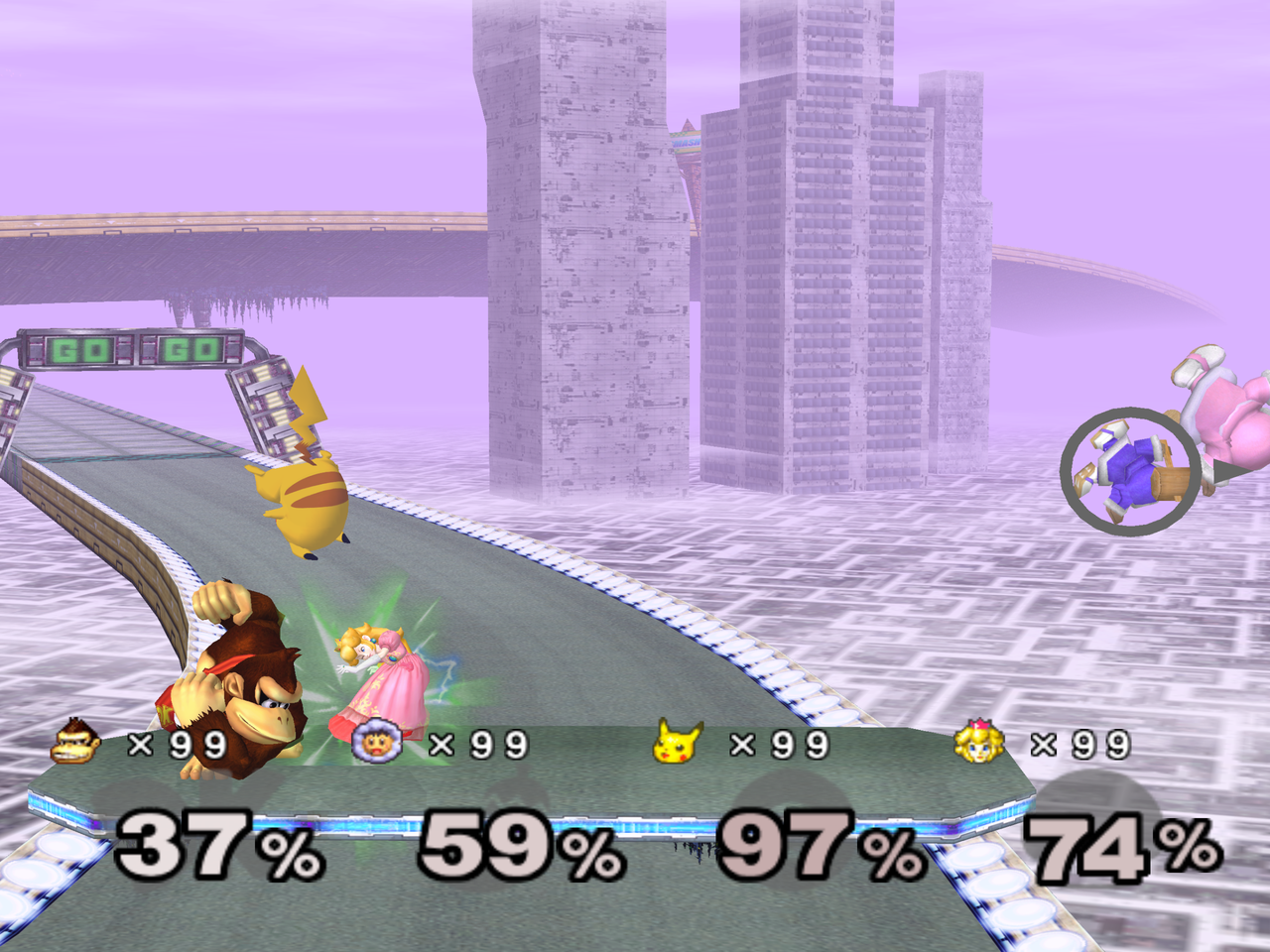
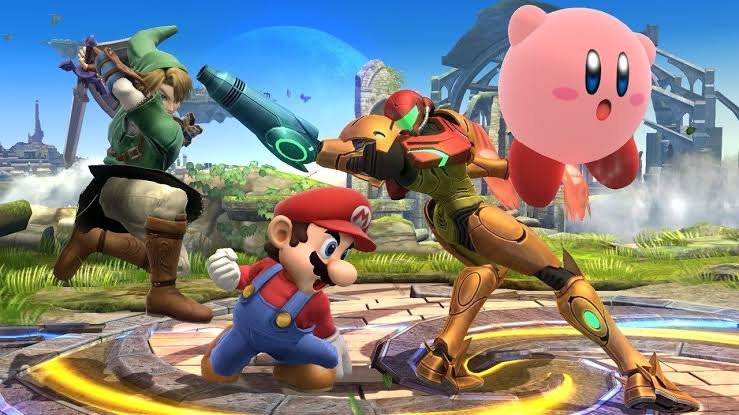
Super Smash Bros. Melee running via the native melee-pc port. The image shows a local match, not a demonstration of the new online multiplayer. Image: 999sian/melee-pc.
Super Smash Bros. Melee gets online multiplayer with three modes
The new infrastructure was announced in the official release v0.1.10-beta of melee-pc, published on September 21, 2026, at 4:24 PM UTC, equivalent to 1:32 PM Brasília time.
The project, developed by 999sian and collaborators, had already introduced local area network matches and direct IP connection in version v0.1.8-beta, released on September 19.
The difference is that the new update adds a mechanism for discovering and negotiating internet connections, expanding the possibilities of multiplayer integrated directly into the game.
The developers implemented three modes:
- Direct: allows you to connect directly to another player using a connection code.
- Unranked: offers a game mode without competitive ranking.
- Ranked: introduces ranked matches played in best-of-three series.
These modalities use signed records for connection discovery and negotiation on the public Mainline DHT network.
DHT, an acronym for Distributed Hash Table (distributed hash table), is a technology used in decentralized networks to locate information and participants without centralizing all discovery on a single server.
In melee-pc, this infrastructure acts as a meeting point among players. After discovery, the system attempts to establish direct communication between the participants.
To this end, the implementation also uses techniques of UDP hole punching, which seek to bypass connection restrictions imposed by routers and Network Address Translation systems, known as NAT.
The goal is to enable connections between users from different networks, including situations involving mobile connections and configurations with multiple NATs.
This does not mean that every player can already find an online match without problems. The full functioning of these connections still depends on additional testing, especially when both participants are behind NATs.
Rollback arrives on all platforms and improves netcode
Another change in the update is related to the system responsible for keeping matches synchronized over the network.
melee-pc now provides rollback snapshots on all supported platforms. As a result, Windows and macOS no longer depend exclusively on the lockstep synchronization system from the very first frame.
Rollback is a technique used in fighting games to reduce the noticeable effects of connection lag. The game can temporarily predict the opponent's actions and, when it receives the actual inputs, restore a previous state of the match and recalculate the simulation if the prediction was incorrect.
In traditional lockstep, execution may need to wait for the arrival of the necessary inputs to keep participants synchronized, increasing the feeling of input delay.
The rollback system in melee-pc uses snapshots of the game states to allow these corrections during matches.
The feature had already been experimentally introduced in version v0.1.8-beta. The new addition in v0.1.10-beta is expanding the availability of snapshots to all supported platforms, including Windows and macOS.
However, the developers still do not guarantee simulation determinism across different platforms. Therefore, the existence of builds for multiple operating systems should not be interpreted as a guarantee of stable matches among all of them.
Direct connection and player discovery also received fixes
Version v0.1.10-beta also modifies how Direct Connect works, a feature intended to connect players through codes.
Previously, the lobby could silently reuse a code stored in the launcher. This created situations where two players accessed the mode, but each ended up hosting their own session, preventing them from finding each other.
Now, the game requests the connection code directly in the lobby.
The user can enter a friend's code to try and establish the connection or leave the field empty to host a session and share their own code.
Other documented fixes include:
- Faster discovery: the game now immediately announces the player's presence on the DHT, without waiting for the next periodic publication window.
- New connection attempts: after an unsuccessful direct session, the system returns to the code entry instead of restarting like a public search.
- Disconnections: improvements to session termination and the handling of players who leave normally.
- Lobby: fix for an issue that could cause increasing memory consumption while the system waited for another participant.
- Stage selection: restoration of stage selection in Unranked and LAN matches.
The developers note that the retry mechanism after a failed direct connection has been revised, but has not yet undergone full practical testing involving a second player.
What is melee-pc and why is it not an emulator?
melee-pc is a community native port project of Super Smash Bros. Melee, originally released for the Nintendo GameCube.
Unlike running through the Dolphin emulator, the project uses the code reconstructed by the decompilation work of doldecomp/melee as a basis to produce natively compiled versions for different systems.
The GameCube used an IBM Gekko processor based on the PowerPC architecture. Instead of directly executing the original binary of that architecture via an emulator, melee-pc adapts the reconstructed code to the target processors and operating systems.
The Aurora compatibility layer provides implementations of the services originally used by the game, including GX, OS, PAD, DVD, CARD, and THP.
Rendering uses WebGPU via the Dawn implementation, while the SDL3 library participates in integration with operating systems and devices.
Therefore, it is a native port based on decompilation, and not a direct static recompilation of the original PowerPC executable.
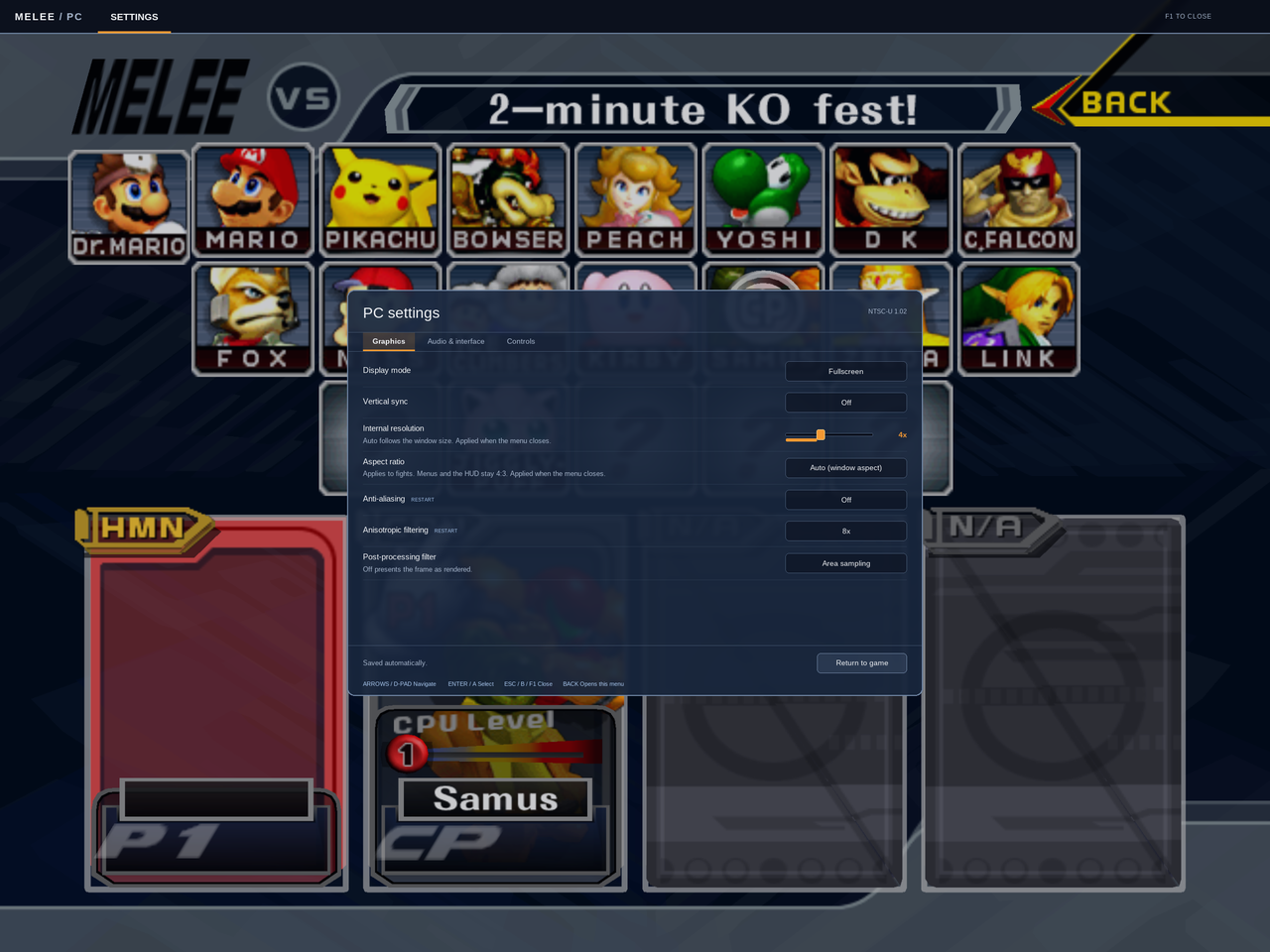
The melee-pc has its own settings interface, with additional graphic features compared to the original game. Image: 999sian/melee-pc.
In addition to multiplayer, the port offers features such as internal resolution adjustments, graphic filters, antialiasing, control remapping, and support for custom texture packs compatible with the format used by Dolphin.
These features are part of the project's general development and should not be confused with features specifically introduced by the September 21 update.
Which platforms are compatible with melee-pc?
Version v0.1.10-beta has public builds for computers and mobile devices, covering different processor architectures.
The platforms listed in the release are:
- Windows: versions for x86-64 and ARM64 processors.
- Linux: x86-64 and ARM64 versions, including AppImage packages.
- macOS: versions for Apple Silicon computers and Intel processors.
- Android: ARM64 version, distributed in APK.
- iOS: ARM64 version for iOS 14 or higher, distributed in IPA for installation via alternative methods.
Graphics requirements vary by system. The project uses APIs like Vulkan, Direct3D and Metal, depending on the platform and available hardware.
The existence of a build, however, does not mean that operation is equally validated on all devices.
macOS versions remain experimental, and the build intended for Intel computers had not yet been tested on Intel hardware, according to the update notes.
On Android, there are also reports of devices where the app closes before displaying the launcher.
Do I need to own a copy of the original game?
Yes. melee-pc does not distribute the commercial Super Smash Bros. Melee files alongside the executables.
To use the port, you need to provide a disk image of your own game.
The officially supported version is the North American NTSC-U 1.02 edition, identified by the code GALE01.
An image of the European PAL edition, identified as GALP01, can also boot experimentally, but it uses the North American version code with European edition data and exhibits compatibility limitations.
The project accepts images in ISO, GCM, CISO, and RVZ formats.
The experimental version files are available on the official melee-pc downloads page on GitHub.
Is multiplayer ready for competitive matches yet?
There is still no confirmation that all components of the new infrastructure work reliably in real matches over the internet.
The release notes for version v0.1.10-beta itself identify the multiplayer as a prototype and highlight important limitations:
- Information storage on the public DHT network has been validated.
- Pairing between two players protected by NATs has not yet been proven.
- The acceptance of actual ranked matches still needs to be tested.
- Simulation determinism across different platforms is not guaranteed.
- Competitive rankings are calculated by the community and do not yet have independent verification.
This means that the implementation of the Ranked and Unranked modes represents progress in development, but does not prove, in itself, the existence of a fully functional competitive environment.
The release also warns of the possibility of crashes and missing features, characteristics expected at this experimental stage.
The September 21 update marks the transition of melee-pc from a LAN match system and direct IP connection to an internet multiplayer infrastructure integrated into the port.
The next step will be to verify connection performance under real conditions, rollback stability, and cross-platform compatibility.
If these components are validated, the project may offer a native alternative for online matches of Super Smash Bros. Melee, without requiring the original game to be run through an emulator.
Sources: melee-pc — official release v0.1.10-beta | melee-pc — previous update with rollback and LAN | melee-pc — repository and documentation | doldecomp/melee — decompilation project.